A-Tech 32GB (2x16GB) DDR4 2133MHz or A-Tech 16GB DDR4 2666MHz ECC? Which A-Tech Model to Buy
As an Amazon Associate we earn from qualifying purchases. Links on this page are affiliate links.
This comparison covers the a tech 32gb vs 16gb RAM replacement hynix options. Both kits operate at 1.2V, but they serve different hardware needs. The first is a 32GB laptop kit with non-ECC memory. The second is a 16GB server-grade module with ECC and registered features. You must choose based on your device type and error-correction needs. These specs dictate compatibility and stability.
Key differences
| Aspect | A-Tech 32GB (2x16GB) DDR4 2133MHz SODIMM Kit | A-Tech 16GB DDR4 2666MHz ECC RDIMM |
|---|---|---|
| Capacity | 32GB (2x16GB) | 16GB (1x16GB) |
| Form Factor | SO-DIMM | RDIMM |
| Memory Speed | 2133MHz | 2666MHz |
| ECC Support | Non-ECC | ECC RDIMM |
| Compatible Device | Laptop | Server/Workstation |
Which one should you choose?
Choose A-Tech 32GB (2x16GB) DDR4 2133MHz SODIMM Kit if
- You need to upgrade a laptop with limited space for SO-DIMM slots.
- You require 32GB of total memory for heavy multitasking.
- Your system does not support Registered or ECC memory.
Choose A-Tech 16GB DDR4 2666MHz ECC RDIMM if
- You are replacing memory in a server or workstation that requires RDIMM.
- You need ECC error correction for data integrity.
- Your system supports 2666MHz speeds for better bandwidth.
Verdict: Choose the 32GB SO-DIMM kit if you are upgrading a laptop and need higher capacity. Select the 16GB ECC RDIMM only if your hardware explicitly supports registered server memory. These modules are not interchangeable due to their different form factors and error-correction features.
DDR4 Laptop vs Server RAM
Memory speed
The A-Tech 16GB DDR4 2666MHz ECC RDIMM operates at a higher frequency than the 32GB kit. Product B runs at 2666MHz, which allows for faster data transfer rates between the memory and the processor. Product A is rated at 2133MHz. For most users, higher MHz means quicker application loading and smoother multitasking. However, this speed advantage only matters if your system supports 2666MHz. Laptop systems using SODIMMs typically cap at lower speeds, while server platforms often utilize the higher bandwidth of registered DIMMs. You must match the speed to your motherboard's maximum supported frequency to see any benefit.
Total capacity
If you need more space for large datasets or heavy virtualization, the 32GB kit is the clear choice. Product A provides 32GB total capacity, achieved through two 16GB modules. This is ideal for modern laptops running multiple demanding applications simultaneously. Product B offers only 16GB in a single module. While 16GB is sufficient for many standard tasks, it may bottleneck systems that require extensive memory allocation. The dual-rank configuration of the 32GB kit also helps balance memory access across the two sticks. You should choose the higher capacity if your workflow involves video editing, large spreadsheet analysis, or running several virtual machines at once.
Compatible device
These modules are designed for completely different types of computers. Product A is a SODIMM, which stands for Small Outline DIMM. This form factor is standard for laptops and compact notebooks. It fits into the smaller memory slots found in portable devices. Product B is an RDIMM, or Registered DIMM. This is a full-size module designed for desktop workstations and servers. It will not fit into a laptop slot. You must check your device type before purchasing. Using the wrong form factor will prevent installation entirely. The laptop kit is for portable computing, while the server module is for stationary, high-performance computing environments.
ECC support
Error Correction Code (ECC) memory detects and fixes data corruption automatically. Product B includes ECC support, specifically as an RDIMM. This is critical for servers and workstations where data integrity is paramount. A single bit flip can cause system crashes or corrupted files. Product A is Non-ECC. It does not have this error-checking capability. While Non-ECC is standard and sufficient for most laptops, it lacks the reliability features of ECC. If you are building a system for financial calculations, scientific research, or 24/7 server operations, the ECC feature in Product B is essential. For casual laptop use, this feature is unnecessary.
CAS latency
CAS Latency (CL) measures the delay between a command and the availability of data. Product A specifies a CAS Latency of CL15. This is a standard timing for DDR4 2133MHz memory. Product B does not list its specific CAS Latency in the provided data. Generally, higher speeds like 2666MHz may have higher absolute latency numbers but still offer better performance due to bandwidth. Without the specific CL value for the 16GB module, we cannot directly compare the timing efficiency. You should assume both meet JEDEC standards for their respective speeds. The lower latency of Product A might feel snappier in some desktop scenarios, but the speed difference of Product B often compensates.
Voltage
Both modules operate at 1.2V. This is the standard voltage for DDR4 memory. It represents a significant improvement over older DDR3, which often ran at 1.5V. The lower voltage reduces power consumption and heat generation. This is beneficial for laptops, as it helps extend battery life. It is also beneficial for servers, as it reduces cooling requirements and energy costs. Since both products share this specification, there is no difference in power efficiency between them. You can expect similar thermal outputs relative to their respective speeds and capacities. This standard voltage ensures compatibility with any DDR4 slot designed for modern memory modules.
Which A-Tech RAM Kit Fits You
Laptop users needing high capacity
This kit provides 32GB of total capacity across two 16GB modules. It uses the SODIMM form factor, which is required for most laptop computers. The 2133MHz speed and CL15 latency are standard for this class. You get non-ECC memory, which is typical for consumer laptops. This configuration maximizes multitasking ability within the physical constraints of a portable device.
Server or workstation builders
This module features ECC RDIMM technology, which detects and corrects data errors. This is essential for server stability and professional workstations. It uses the 288-pin RDIMM form factor, distinct from laptop memory. The 2666MHz speed offers higher bandwidth than the laptop option. It is designed for systems that require registered memory and error correction capabilities for critical data integrity.
Users prioritizing memory speed
If data transfer rate is your main concern, this module runs at 2666MHz. This is faster than the 2133MHz speed of the laptop kit. The higher frequency allows for quicker communication between the RAM and the processor. You must ensure your system supports RDIMM modules. This choice is best for desktop or server environments where speed and registered memory architecture are compatible with your hardware.
The products compared

A-Tech 32GB (2x16GB) DDR4 2133MHz SODIMM Kit
Best for: Laptops needing 32GB non-ECC capacity
- Total Capacity
- 32GB
- Memory Speed
- 2133 MHz
- CAS Latency
- CL15
- Voltage
- 1.2V
- Module Configuration
- 2x16GB
- Form Factor
- SODIMM
View on Amazon: A-Tech 32GB (2x16GB) DDR4 2133MHz SODIMM Kit Affiliate link
This A-Tech kit gives you 32GB of DDR4 SODIMM memory in a 2x16GB configuration. It runs at 2133MHz with CL15 latency and operates at 1.2V. The modules are non-ECC and dual rank. You get more total capacity than the 16GB alternative, though the speed is lower. It fits standard laptop slots and supports easy installation without special tools.
Pros
- Provides 32GB total capacity via two 16GB modules
- Standard 1.2V voltage for efficient power use
- Compatible with select DDR4 laptop computers
- Dual rank 2Rx8 architecture for stable performance
Cons
- Lower 2133MHz speed compared to 2666MHz options
- Non-ECC memory lacks error correction
- Higher CL15 latency than faster kits
Good fit if
- You need maximum RAM capacity for heavy multitasking
- Your laptop uses DDR4 SODIMM slots
- You prioritize total memory over clock speed
Skip if
- You require ECC memory for data integrity
- Your system requires 2666MHz or higher speeds
- You only need 16GB of total RAM
Verdict: A-Tech 32GB DDR4 2133MHz Non-ECC offers high capacity for laptops that do not need error correction. It suits users who value total memory volume over higher clock speeds.
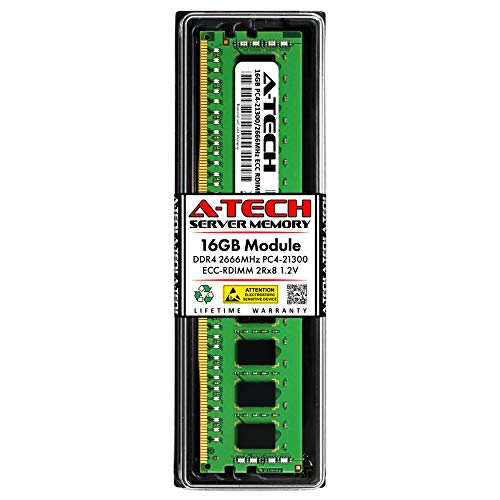
A-Tech 16GB DDR4 2666MHz ECC RDIMM
Best for: Single-slot ECC server upgrades
- Total Capacity
- 16GB
- Memory Speed
- 2666 MHz
- Voltage
- 1.2V
- Module Configuration
- 1x16GB
- Form Factor
- RDIMM
- ECC Support
- ECC
View on Amazon: A-Tech 16GB DDR4 2666MHz ECC RDIMM Affiliate link
This A-Tech module is a 16GB DDR4 replacement for the Hynix HMA82GR7CJR8N-VK. It runs at 2666MHz with ECC RDIMM support on a 288-pin form factor. The 1.2V voltage ensures standard power efficiency. You should choose this if your server requires registered memory with error correction. It offers a single 16GB stick rather than a dual-channel pair.
Pros
- 2666MHz memory speed
- ECC RDIMM support
- 1.2V operating voltage
- 288-pin form factor
Cons
- 16GB capacity is half the 32GB option
- Single stick limits dual-channel performance
- No CL latency specification listed
Good fit if
- You need a direct replacement for a Hynix HMA82GR7CJR8N-VK slot
- Your server requires ECC registered memory
- You are expanding a single 16GB slot
Skip if
- You need 32GB of total capacity
- You require dual-channel 2x16GB configuration
- Your system uses unbuffered UDIMM slots
Verdict: A-Tech 16GB DDR4 2666MHz ECC RDIMM fits users needing a single high-speed registered stick. It suits those replacing a specific Hynix module rather than upgrading total capacity.
Specifications side by side
| Spec | A-Tech 32GB (2x16GB) DDR4 2133MHz SODIMM Kit | A-Tech 16GB DDR4 2666MHz ECC RDIMM |
|---|---|---|
| Total Capacity | 32GB | 16GB |
| Memory Speed | 2133 MHz | 2666 MHz |
| CAS Latency | CL15 | not stated |
| Voltage | 1.2V | 1.2V |
| Module Configuration | 2x16GB | 1x16GB |
| Form Factor | SODIMM | RDIMM |
| ECC Support | Non-ECC | ECC |
| Compatible Device | Laptop | not stated |
| Size | 32GB (2 x 16GB) | 16GB |
| Dimensions | 2.74 × 1.18 × 0.15 inches | 5.25 × 1.23 × 0.15 inches |
| Color | DDR4 2133 (PC4-17000) | not stated |
| Model | AT16G2D4S2133ND8N12V | HMA82GR7CJR8N-VK-ATC |
Frequently asked questions
Can I use the 32GB laptop kit in a server?
No, you cannot use the 32GB kit in a server. It uses the SODIMM form factor, which is designed for laptops. Server motherboards typically require RDIMM modules. The physical size and pin configuration are different. You must choose the 16GB RDIMM for server hardware compatibility.
Does the 16GB module include error correction?
Yes, the 16GB module includes error correction. It is specified as an ECC RDIMM. This feature helps detect and fix data errors, which is important for server stability. The 32GB laptop kit does not offer this capability, as it is a Non-ECC module.
Which RAM is faster for data transfer?
The 16GB module is faster. It operates at 2666MHz, while the 32GB kit runs at 2133MHz. Higher frequency allows for quicker data transfer between memory and the processor. If speed is your priority, the 16GB RDIMM is the better choice over the slower laptop kit.
What is the difference between SODIMM and RDIMM?
SODIMM and RDIMM are different physical forms. SODIMM is smaller and used in laptops, like the 32GB kit. RDIMM is larger and used in servers, like the 16GB module. They are not interchangeable. You must match the form factor to your device type to ensure it fits.
Is the 32GB kit good for high capacity needs?
Yes, the 32GB kit is ideal for high capacity needs. It provides 32GB total across two 16GB modules. This is double the capacity of the single 16GB stick. If you need more space for multitasking in a laptop, this kit offers the volume you require.
Can I mix these two RAM kits together?
You should not mix these two kits. They have different form factors, speeds, and technologies. One is SODIMM Non-ECC, and the other is RDIMM ECC. They are designed for completely different systems. Mixing them will likely prevent your computer from booting or cause instability.