CAS Latency in DDR5 RAMs: What It Is and Is It Worth It?
As an Amazon Associate we earn from qualifying purchases. Links on this page are affiliate links.
Understanding Cas Latency In Ddr5
Cas latency explained reveals how quickly memory responds to commands. This number defines the delay between when your processor requests data and when the RAM module begins to deliver it. In DDR5 technology, this specification is critical for system responsiveness. You will see values like CL38, CL40, CL36, and CL30 on product listings. These numbers represent clock cycles. A lower number indicates a shorter delay. This means faster data access. When you are gaming or editing video, this speed matters. It reduces the time your CPU waits for information. The timing works in conjunction with the memory frequency. Higher frequencies often allow for slightly higher latency numbers without sacrificing performance. However, within the same speed tier, a lower CAS latency is always better. You should check the full timing string, not just the speed. The primary keyword helps you find detailed guides on this topic. Buyers care because it affects real-world frame rates and application loading times. A kit with CL30 will generally outperform one with CL40 at the same frequency. This difference is measurable in benchmarks. It is not just a marketing number. It is a physical property of the memory chips. You need to balance this with voltage and temperature stability. Extreme overclocking can lower these numbers, but it requires careful tuning. For most users, stock settings provide the best balance. The specific value you choose depends on your motherboard support. Some boards handle tighter timings better than others. Always verify compatibility before purchasing. This spec is a key part of the overall memory profile. It ensures your system runs smoothly under load.
DDR5 CAS Latency Options
CAS Latency: CL30
CL30 represents the tightest timing among common DDR5 kits. This low latency reduces the delay between command and data delivery. It suits users prioritizing peak responsiveness in gaming or heavy multitasking. The G.SKILL Trident Z5 Neo 64GB DDR5-6000 CL30 exemplifies this tier, offering high capacity with minimal delay for AMD platforms. You gain faster access to frequently used data. The trade-off is typically higher cost and stricter compatibility requirements. Not all motherboards stabilize CL30 at high speeds. You must verify your CPU and board support these tight timings. This option is ideal if your workflow demands the lowest possible memory latency.
CAS Latency: CL36
CL36 offers a balanced approach for most DDR5 systems. It provides solid performance without the premium price of CL30. The G.SKILL Trident Z5 RGB 32GB 6000MHz RAM is a strong example here, supporting both Intel XMP and AMD EXPO profiles. You get reliable speeds for gaming and content creation. This latency level suits builders who want broad compatibility across different platforms. The trade-off is slightly higher delay compared to CL30. However, the difference is often negligible in everyday tasks. You benefit from easier overclocking stability and wider motherboard support. This option works well for users seeking a middle ground between cost and speed.
CAS Latency: CL38
CL38 is a moderate latency setting often found in standard DDR5 kits. It balances performance with stability for general use. The TEAMGROUP T-Force Delta RGB 32GB 6000MHz DDR5 RAM fits this category, offering stable timings for users who value visual style and moderate speed. You get adequate performance for productivity and light gaming. The trade-off is slower response times compared to CL36 or CL30. This latency is suitable for builders who prioritize compatibility and aesthetics over extreme benchmarks. You may not see significant gains in CPU-bound tasks. However, it remains a safe choice for users who want reliable performance without complex tuning.
CAS Latency: CL40
CL40 is the highest latency among these options, typical for entry-level DDR5 modules. The Crucial 16GB DDR5 4800MHz Desktop RAM uses this setting, focusing on reliability and standard speeds. It suits users who need basic memory for office work or media consumption. You get stable performance for standard computing tasks. The trade-off is noticeably slower data access compared to lower latency kits. This option is ideal for budget-conscious builders or those prioritizing compatibility over speed. You will not see gains in gaming or heavy multitasking. However, it provides a solid foundation for everyday use. This latency level is best for users who do not require high-performance memory features.
Is Low Latency Worth The Cost
Who needs it
You should prioritize lower CAS Latency if you run latency-sensitive applications. Titles like competitive first-person shooters benefit significantly from faster data delivery. A CL30 kit reduces the delay between your CPU request and memory response. This improvement can stabilize frame times and reduce input lag. Gamers seeking maximum responsiveness will notice the difference in fast-paced scenarios. Professionals using complex simulations or real-time data processing also gain from tighter timings. If your workflow involves heavy multitasking with large datasets, lower latency helps maintain smooth performance. You should look for CL36 or CL30 options. These values offer the best balance of speed and responsiveness for demanding tasks. Higher speeds alone do not compensate for high latency in these specific use cases. Your system feels snappier when the memory responds quicker to immediate commands.
Who can skip it
You can ignore CAS Latency if you perform general productivity tasks. Web browsing, document editing, and media consumption do not stress memory timing. The difference between CL30 and CL40 is negligible in these scenarios. You should prioritize capacity and speed instead. Larger modules handle more open applications without slowing down. Higher clock speeds improve data transfer rates for general use. Budget-conscious buyers should focus on getting the most gigabytes for their budget. A CL38 or CL40 kit offers better value for everyday computing. You save money by choosing higher latency modules that still meet your speed requirements. The performance gain from lower latency is too small to justify the premium. Focus on reliability and compatibility rather than tight timings for standard office work.
DDR5 Memory Glossary
CAS Latency
The delay in clock cycles between a command and data availability. Lower numbers mean faster response times for your processor requests.
DDR5
The latest memory standard offering higher speeds and efficiency. It uses on-die ECC to improve data integrity compared to older generations.
MHz
Megahertz, measuring how many millions of cycles occur per second. Higher values indicate faster data transfer rates between RAM and CPU.
Voltage
The electrical power required for operation. DDR5 typically runs at 1.1 volts, which is lower than previous standards for better efficiency.
XMP
Intel Extreme Memory Profile. This setting allows the motherboard to automatically apply faster speeds and tighter timings than the base standard.
CL30
A common low-latency rating for high-performance DDR5 kits. It represents a tight timing window that improves system responsiveness in gaming.
Form Factor
The physical shape and size of the module. Desktop kits use DIMMs, while laptops use smaller SO-DIMMs to fit specific chassis.
Quick picks
| # | Product | Best for | Price |
|---|---|---|---|
| 1 | Crucial 16GB DDR5 4800MHz Desktop RAM | Standard desktop productivity and basic multitasking | Check price of Crucial 16GB DDR5 4800MHz Desktop RAM on Amazon |
| 2 | G.SKILL Trident Z5 RGB 32GB 6000MHz RAM | Low-latency DDR5 performance on Intel or AMD | Check price of G.SKILL Trident Z5 RGB 32GB 6000MHz RAM on Amazon |
| 3 | G.SKILL Trident Z5 Neo 64GB DDR5-6000 CL30 | AMD desktops needing 64GB low-latency RAM | Check price of G.SKILL Trident Z5 Neo 64GB DDR5-6000 CL30 on Amazon |
| 4 | TEAMGROUP T-Force Delta RGB 32GB 6000MHz DDR5 RAM | White-themed builds needing balanced DDR5 specs | Check price of TEAMGROUP T-Force Delta RGB 32GB 6000MHz DDR5 RAM on Amazon |
| 5 | G.SKILL Trident Z5 RGB 32GB 6000MHz RAM | Balanced DDR5 performance on Intel and AMD systems | Check price of G.SKILL Trident Z5 RGB 32GB 6000MHz RAM on Amazon |
| 6 | G.SKILL Trident Z5 RGB 32GB 6000MHz CL30 | Intel gaming builds needing low latency | Check price of G.SKILL Trident Z5 RGB 32GB 6000MHz CL30 on Amazon |
Our 6 picks

Crucial 16GB DDR5 4800MHz Desktop RAM
Best for: Standard desktop productivity and basic multitasking
- CAS Latency
- CL40 (what this guide is about)
- Capacity
- 16GB
- Memory Speed
- 4800MHz
- Form Factor
- 288-pin UDIMM
- Overclocking Profile
- Intel XMP 3.0, AMD EXPO
- Voltage
- 1.1V
View on Amazon: Crucial 16GB DDR5 4800MHz Desktop RAM Affiliate link
This Crucial 16GB DDR5 module runs at 4800MHz with a CAS Latency of CL40. It uses a standard UDIMM form factor and operates at 1.1V. The kit supports both Intel XMP 3.0 and AMD EXPO profiles. It is designed for 13th Gen Intel Core and AMD Ryzen 7000 Series processors. You get reliable performance for general desktop tasks and multitasking.
Pros
- 16GB capacity for standard desktop use
- 4800MHz base memory speed
- Supports Intel XMP 3.0 and AMD EXPO
- Low 1.1V operating voltage
Cons
- Higher CL40 latency compared to faster kits
- Lower 4800MHz speed limit
- Only 16GB total capacity
Good fit if
- You need basic DDR5 compatibility
- You are building a budget desktop
- You prioritize stability over speed
Skip if
- You require high-frequency overclocking
- You need more than 16GB per stick
- You want lower CAS latency
Verdict: Crucial 16GB DDR5 4800MHz Desktop RAM offers solid entry-level performance for standard computing. It fits users who value reliable compatibility and standard speeds over high-end gaming metrics.

G.SKILL Trident Z5 RGB 32GB 6000MHz RAM
Best for: Low-latency DDR5 performance on Intel or AMD
- CAS Latency
- CL36 (what this guide is about)
- Capacity
- 32GB
- Memory Speed
- Up to 6000MT/s
- Kit Configuration
- 2x16GB
- Form Factor
- 288-pin U-DIMM
- Overclocking Profile
- Intel XMP 3.0 & AMD EXPO
View on Amazon: G.SKILL Trident Z5 RGB 32GB 6000MHz RAM Affiliate link
This G.SKILL kit offers 32GB of DDR5 memory running at 6000MT/s with a CAS Latency of CL36. It supports both Intel XMP 3.0 and AMD EXPO for easy overclocking on compatible platforms. The matte black design fits most builds. You get a matched pair of 16GB modules. This setup is ideal for users seeking low latency and broad CPU compatibility.
Pros
- CL36 CAS Latency for faster data access
- 6000MT/s memory speed
- Supports Intel XMP 3.0 and AMD EXPO
- Non-ECC 288-pin U-DIMM form factor
Cons
- Requires BIOS adjustments to reach rated speed
- Non-ECC memory lacks error correction
- Matte black color limits aesthetic options
Good fit if
- You want low latency with CL36 timing
- You use either Intel or AMD desktop platforms
- You need 32GB of matched memory
Skip if
- You require error-correcting ECC memory
- You prefer white RAM modules
- You cannot adjust BIOS settings
Verdict: G.SKILL Trident Z5 RGB 32GB 6000MHz delivers tight CL36 timings and broad platform support for gamers and creators. It suits builders who prioritize speed and compatibility over automatic setup.

G.SKILL Trident Z5 Neo 64GB DDR5-6000 CL30
Best for: AMD desktops needing 64GB low-latency RAM
- CAS Latency
- CL30 (what this guide is about)
- Capacity
- 64GB
- Memory Speed
- 6000MT/s
- Kit Configuration
- 2x32GB
- Form Factor
- 288-pin U-DIMM
- Overclocking Profile
- AMD EXPO
View on Amazon: G.SKILL Trident Z5 Neo 64GB DDR5-6000 CL30 Affiliate link
This G.SKILL kit offers 64GB of DDR5 memory running at 6000MT/s with a tight CL30 latency. It uses AMD EXPO profiles for easy overclocking on supported platforms. The black U-DIMM design fits standard desktop builds. You get a high-capacity, low-latency option for content creators or heavy multitaskers who need ample space without sacrificing speed on AMD systems.
Pros
- 64GB total capacity in a 2x32GB configuration
- Fast 6000MT/s memory speed
- Tight CL30 CAS latency
- AMD EXPO support for simplified overclocking
Cons
- Limited to AMD platforms only
- Requires BIOS adjustments for full speed
- Non-ECC memory standard
Good fit if
- You need 64GB of RAM for heavy workloads
- You use an AMD Ryzen system with EXPO support
- You prioritize low latency over RGB aesthetics
Skip if
- You are building with an Intel processor
- You require ECC memory for stability
- You want plug-and-play speeds without BIOS changes
Verdict: G.SKILL Trident Z5 Neo 64GB DDR5 delivers high capacity and speed for AMD users. It suits those needing 64GB for demanding tasks. You should buy it if you have an AMD platform and want low latency.

TEAMGROUP T-Force Delta RGB 32GB 6000MHz DDR5 RAM
Best for: White-themed builds needing balanced DDR5 specs
- CAS Latency
- CL38 (what this guide is about)
- Capacity
- 32GB
- Memory Speed
- 6000MHz
- Kit Configuration
- 2x16GB
- Overclocking Profile
- Intel XMP 3.0 & AMD Expo
- ECC Support
- On-die ECC
View on Amazon: TEAMGROUP T-Force Delta RGB 32GB 6000MHz DDR5 RAM Affiliate link
This 32GB DDR5 kit runs at 6000MHz with a CAS Latency of CL38. It uses Intel XMP 3.0 and AMD EXPO for easy setup. The design includes RGB lighting and on-die ECC for stability. You get a white heatsink that fits modern builds. This option suits users who want mid-range speed without the highest latency of entry-level kits.
Pros
- 6000MHz memory speed for solid performance
- CL38 CAS Latency for responsive gaming
- On-die ECC for data stability
- Intel XMP 3.0 and AMD EXPO support
- White RGB heatsink design
Cons
- CL38 is slower than CL30 or CL36 options
- 32GB capacity is less than 64GB kits
- Heatsink height is 1.79 inches
Good fit if
- You want a balanced speed and latency ratio
- You need white RGB aesthetics for your build
- You are using a mid-range CPU platform
Skip if
- You require the lowest possible CAS Latency
- You need 64GB or more of total memory
- You prefer black components for your case
Verdict: TEAMGROUP T-Force Delta RGB 32GB DDR5 offers stable CL38 performance for users who prioritize visual style and moderate speed over maximum overclocking headroom.

G.SKILL Trident Z5 RGB 32GB 6000MHz RAM
Best for: Balanced DDR5 performance on Intel and AMD systems
- CAS Latency
- CL36 (what this guide is about)
- Capacity
- 32GB
- Memory Speed
- 6000MT/s
- Kit Configuration
- 2x16GB
- Form Factor
- 288-pin U-DIMM
- Overclocking Profile
- Intel XMP 3.0 & AMD EXPO
View on Amazon: G.SKILL Trident Z5 RGB 32GB 6000MHz RAM Affiliate link
This G.SKILL kit offers 32GB of DDR5 memory running at 6000MT/s with a CAS Latency of CL36. It uses a 1.35V voltage and includes both Intel XMP 3.0 and AMD EXPO profiles for easy overclocking. The silver heatsink measures 4.8 inches wide. You get two 16GB sticks for dual-channel performance. This setup suits desktop users seeking balanced speed and latency for gaming or content creation.
Pros
- CL36 CAS Latency for tight timing performance
- 6000MT/s memory speed with XMP 3.0 and AMD EXPO support
- 32GB capacity provided as a matched 2x16GB kit
- Non-ECC 288-pin U-DIMM form factor for standard desktops
Cons
- Requires BIOS adjustments to reach maximum advertised speed
- Limited to 32GB total capacity compared to higher-tier kits
- Physical width of 4.8 inches may interfere with large CPU coolers
Good fit if
- You want a balanced CAS Latency of CL36 for stable performance
- You need compatibility with both Intel and AMD platforms
- You are building a desktop PC with standard U-DIMM slots
Skip if
- You require ECC memory for server or workstation stability
- You need more than 32GB of total system memory
- You prefer a lower CAS Latency like CL30 for maximum throughput
Verdict: G.SKILL Trident Z5 RGB 32GB DDR5 delivers solid 6000MT/s speeds with CL36 latency for users who need broad platform support. It fits desktop builders who value balanced timing over extreme capacity or the lowest possible latency.
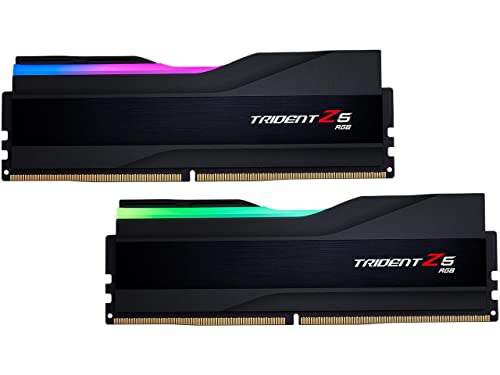
G.SKILL Trident Z5 RGB 32GB 6000MHz CL30
Best for: Intel gaming builds needing low latency
- CAS Latency
- CL30 (what this guide is about)
- Capacity
- 32GB
- Memory Speed
- 6000MT/s
- Kit Configuration
- 2x16GB
- Form Factor
- 288-pin U-DIMM
- Overclocking Profile
- Intel XMP 3.0
View on Amazon: G.SKILL Trident Z5 RGB 32GB 6000MHz CL30 Affiliate link
This G.SKILL kit offers 32GB of DDR5 memory running at 6000MT/s with a tight CAS Latency of CL30. It uses a 2x16GB configuration and supports Intel XMP 3.0 for easy overclocking. The matte black heatsink fits most desktop builds. You get high speed and low latency, which helps gaming performance on compatible Intel platforms like Z790 or Z890 motherboards.
Pros
- Low CL30 CAS Latency for faster response times
- 6000MT/s memory speed for high throughput
- Supports Intel XMP 3.0 for simple setup
- 2x16GB configuration provides 32GB total capacity
Cons
- Intel XMP 3.0 profile limits compatibility to Intel platforms
- Requires BIOS adjustments to reach maximum speed
- Non-ECC memory lacks error correction for critical data
Good fit if
- You use an Intel Z790 or Z890 motherboard
- You want low latency for gaming performance
- You need a 32GB kit in a 2x16GB configuration
Skip if
- You have an AMD motherboard requiring EXPO support
- You need ECC memory for workstation stability
- You prefer a 64GB kit for heavy multitasking
Verdict: G.SKILL Trident Z5 RGB 32GB 6000MHz CL30 delivers fast, low-latency memory for Intel-based gaming PCs. It suits users who prioritize speed and tight timings on compatible Z-series motherboards.
Specifications side by side
| Spec | Crucial 16GB DDR5 4800MHz Desktop RAM | G.SKILL Trident Z5 RGB 32GB 6000MHz RAM | G.SKILL Trident Z5 Neo 64GB DDR5-6000 CL30 | TEAMGROUP T-Force Delta RGB 32GB 6000MHz DDR5 RAM | G.SKILL Trident Z5 RGB 32GB 6000MHz RAM | G.SKILL Trident Z5 RGB 32GB 6000MHz CL30 |
|---|---|---|---|---|---|---|
| Capacity | 16GB | 32GB | 64GB | 32GB | 32GB | 32GB |
| Memory Speed | 4800MHz | Up to 6000MT/s | 6000MT/s | 6000MHz | 6000MT/s | 6000MT/s |
| CAS Latency | CL40 | CL36 | CL30-40-40-96 | CL38 | CL36 | CL30 |
| Kit Configuration | not stated | 2x16GB | 2x32GB | 2x16GB | 2x16GB | 2x16GB |
| Form Factor | 288-pin UDIMM | 288-pin U-DIMM | 288-pin U-DIMM | not stated | 288-pin U-DIMM | 288-pin U-DIMM |
| Overclocking Profile | Intel XMP 3.0, AMD EXPO | Intel XMP 3.0 & AMD EXPO | AMD EXPO | Intel XMP 3.0 & AMD Expo | Intel XMP 3.0 & AMD EXPO | Intel XMP 3.0 |
| Voltage | 1.1V | 1.35V | 1.40V | not stated | 1.35V | 1.35V |
| ECC Support | Non-ECC | Non-ECC | Non-ECC | On-die ECC | Non-ECC | Non-ECC |
| Compatible Device | Desktop | Desktop, PC | Desktop, PC | Desktop | Desktop, PC | Desktop, PC |
| Size | 16GB | 32GB (2x 16GB) | 64GB | 32GB(2x16GB) | 32GB | 32GB (2x16GB) |
| Dimensions | 5.25 × 0.16 × 1.23 inches | 8 × 6 × 3 inches | 6.3 × 5.51 × 0.39 inches | 5.68 × 0.28 × 1.79 inches | 5.91 × 4.8 × 0.59 inches | not stated |
| Weight | not stated | 5.93 ounces | 6.35 ounces | 1.59 ounces | 3.17 ounces | not stated |
| Color | Multicolor | Matte Black | Black | White | Silver | Matte black |
| Model | CT16G48C40U5 | F5-6000J3636F16GA2-TZ5RK | F5-6000J3040G32GX2-TZ5N | FF4D532G6000HC38ADC01 | F5-6000J3636F16GX2 | F5-6000J3040F16GA2-TZ5RK |
Frequently asked questions
Does CAS Latency matter for gaming?
Yes, lower latency improves responsiveness in titles like competitive shooters. The G.SKILL Trident Z5 RGB 32GB 6000MHz CL30 delivers tight timings for Intel gaming PCs. This reduces the delay between CPU requests and memory response. Faster data delivery helps stabilize frame rates during intense scenes.
What is the difference between CL30 and CL40?
CL30 indicates fewer clock cycles of delay compared to CL40. This makes CL30 kits like the G.SKILL Trident Z5 Neo 64GB DDR5-6000 significantly faster at responding to commands. The G.SKILL Trident Z5 RGB 32GB 6000MHz CL36 offers a middle ground. Lower numbers mean quicker data availability for your processor.
Is CL38 good for everyday use?
CL38 provides stable performance for standard computing tasks. The TEAMGROUP T-Force Delta RGB 32GB 6000MHz DDR5 RAM offers this latency for users who prioritize visual style and moderate speed. It suits builders who do not need maximum overclocking headroom. This timing is sufficient for general productivity and multitasking.
Can I use CL40 RAM for gaming?
You can use CL40 RAM, but it offers entry-level performance. The Crucial 16GB DDR5 4800MHz Desktop RAM features CL40 timing. It fits users who value reliable compatibility over high-end gaming metrics. While functional, it lacks the speed benefits of lower latency kits for demanding applications.
Does CAS Latency affect video editing?
Yes, lower latency aids heavy multitasking and large file handling. The G.SKILL Trident Z5 Neo 64GB DDR5-6000 CL30 suits AMD users needing high capacity and speed. It delivers high capacity for demanding tasks. Tight timings ensure your processor accesses large datasets without unnecessary delays.
Is CL36 better than CL30?
No, CL30 is faster than CL36 because it has lower latency. The G.SKILL Trident Z5 RGB 32GB 6000MHz CL36 offers solid balance for broad platform support. However, CL30 kits like the G.SKILL Trident Z5 Neo provide tighter timings. Choose CL30 if you prioritize peak responsiveness over cost savings.