Corsair vs TEAMGROUP: DDR5 RAMs Compared by Specs
As an Amazon Associate we earn from qualifying purchases. Links on this page are affiliate links.
When you compare corsair vs TEAMGROUP ddr5 RAM, you are looking at two 32GB kits designed for desktop PCs. Both use the UDIMM form factor and share a CAS latency of CL40. The main difference lies in their base memory speed and voltage requirements. One kit runs at 4800MHz with 1.1V, while the other operates at 5200MHz with 1.25V. You also need to consider how each handles overclocking and error correction for your specific motherboard.
Key differences
| Aspect | TEAMGROUP Elite 32GB (2x16GB) DDR5 4800MHz UDIMM Kit | Corsair Vengeance DDR5 32GB 5200MHz |
|---|---|---|
| Memory Speed | 4800MHz | 5200MHz |
| Voltage | 1.1V | 1.25V |
| Overclocking Profile | not listed | Intel XMP |
| ECC Support | Non-ECC, On-die ECC | not listed |
Which one should you choose?
Choose TEAMGROUP Elite 32GB (2x16GB) DDR5 4800MHz UDIMM Kit if
- You want lower power consumption at 1.1V
- You need On-die ECC for stability
- You prefer a standard JEDEC profile without software
Choose Corsair Vengeance DDR5 32GB 5200MHz if
- You want higher base speed at 5200MHz
- You want to use Intel XMP profiles
- You want to use iCUE software for control
Verdict: Choose the TEAMGROUP kit if you prioritize energy efficiency and built-in on-die ECC stability. Pick the Corsair Vengeance if you want a faster 5200MHz base speed and the flexibility of Intel XMP profiles. Both provide the same 32GB capacity and CL40 latency for your desktop PC.
DDR5 Specs: Corsair vs Teamgroup
Memory Speed
The Corsair Vengeance kit operates at a base memory speed of 5200MHz. This is 400MHz faster than the TEAMGROUP Elite, which runs at 4800MHz. Higher frequencies allow data to move between the RAM and CPU more quickly. This can reduce latency in tasks that rely heavily on memory bandwidth, such as video rendering or large file transfers. If your motherboard supports higher speeds, the Corsair module provides a faster baseline performance out of the box. The TEAMGROUP option is sufficient for standard computing, but the Corsair gives you a speed advantage for demanding workloads.
Voltage
Voltage requirements differ between these two kits. The Corsair Vengeance uses 1.25V to operate. The TEAMGROUP Elite runs at a lower 1.1V. Lower voltage generally means less power consumption and potentially lower heat output during operation. This can contribute to better energy efficiency and slightly cooler system temperatures. However, higher voltage can sometimes support more stable overclocking headroom depending on the silicon quality. For standard use, the TEAMGROUP kit is more power-efficient, while the Corsair uses more power to achieve its higher speed.
ECC Support
Error correction capabilities vary in how they are implemented. The TEAMGROUP Elite features On-die ECC, which self-corrects DRAM cells to deliver stability. It is listed as Non-ECC in the main attributes, meaning it lacks the separate ECC chip found in server-grade memory. The Corsair Vengeance does not mention On-die ECC in its provided specifications. For desktop users, On-die ECC provides an extra layer of data integrity without the cost of full ECC modules. This makes the TEAMGROUP kit more suitable for users prioritizing data stability and error prevention in their daily computing tasks.
Overclocking Profile
Software integration for performance tuning is a key differentiator. The Corsair Vengeance includes custom Intel XMP 3.0 profiles that can be customized and saved via the CORSAIR iCUE software. This allows you to tailor performance by app or task. It also features onboard voltage regulation for more stable overclocking. The TEAMGROUP Elite specifications do not mention specific software integration or advanced XMP customization features. If you want to fine-tune your system performance using dedicated software, the Corsair kit offers a more robust ecosystem for managing your memory settings.
Form Factor
Both kits use the standard 288-pin UDIMM form factor, designed for desktop motherboards. They are compatible with standard desktop PC cases and motherboards that support DDR5 memory. The physical dimensions are similar, though the Corsair module is slightly wider at 1.4 inches compared to the unspecified width of the TEAMGROUP stick. Both fit in standard DIMM slots without requiring special clearance. Since both adhere to the same industry standard for desktop memory, there is no significant advantage for either product in terms of physical compatibility with your motherboard.
Which DDR5 RAM Kit Should You Choose
Users needing higher base speed and software control
The Corsair Vengeance kit runs at 5200MHz, offering faster data transfer than the 4800MHz TEAMGROUP option. It also includes onboard voltage regulation and supports custom Intel XMP 3.0 profiles via iCUE software. This allows you to tailor performance by app, ensuring your high-end CPU receives data quickly for rendering and multitasking tasks.
Users prioritizing energy efficiency and basic stability
The TEAMGROUP Elite kit operates at a lower 1.1V voltage, which improves energy efficiency compared to the Corsair 1.25V requirement. It features JEDEC DDR5 on-die ECC to self-correct DRAM cells for stability. This kit is a solid choice if you prefer standard voltage operation and built-in error correction without needing advanced software customization.
Buyers seeking a warranty with technical support
TEAMGROUP explicitly offers a lifetime warranty and free technical support with this kit. While both kits share CL40 latency and 32GB capacity, this coverage provides long-term peace of mind. If you value direct manufacturer support and a comprehensive warranty alongside standard DDR5 specifications, this option ensures you have assistance available for the life of the product.
The products compared

TEAMGROUP Elite 32GB (2x16GB) DDR5 4800MHz UDIMM Kit
Best for: Budget builds and stable daily computing
- Capacity
- 32GB
- Memory Speed
- 4800MHz
- CAS Latency
- CL40
- Kit Configuration
- 2x16GB
- Form Factor
- 288 Pin UDIMM
- Voltage
- 1.1V
View on Amazon: TEAMGROUP Elite 32GB (2x16GB) DDR5 4800MHz UDIMM Kit Affiliate link
This TEAMGROUP kit offers 32GB of DDR5 memory running at 4800MHz with CL40 latency. It uses standard 1.1V voltage and includes on-die ECC for stability. The non-ECC UDIMM form factor fits most desktop PCs. You get a reliable baseline speed for everyday computing and multitasking without the premium cost of higher frequencies.
Pros
- 32GB capacity in a 2x16GB kit configuration
- On-die ECC for improved data stability
- Low 1.1V operating voltage for efficiency
- Standard UDIMM form factor for broad compatibility
Cons
- Slower 4800MHz speed compared to 6000MHz options
- Higher CL40 latency than tighter timings
- No RGB lighting or aesthetic customization
Good fit if
- You need a budget-friendly DDR5 upgrade
- You prioritize system stability over peak speed
- You are building a standard office or home PC
Skip if
- You require high-frequency memory for gaming
- You want RGB lighting for your build
- You need the lowest possible latency timings
Verdict: TEAMGROUP Elite DDR5 32GB 4800MHz is a solid entry-level choice for users who value stability and efficiency. It fits well in systems where maximum speed is not the primary goal.
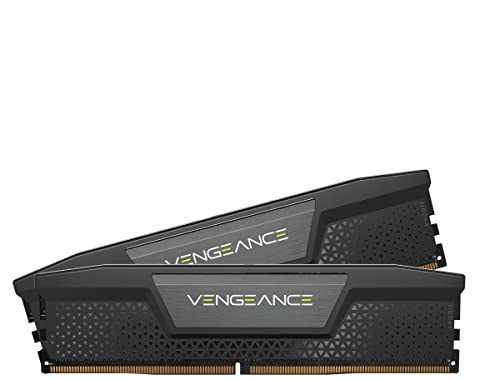
Corsair Vengeance DDR5 32GB 5200MHz
Best for: Desktop users wanting stable DDR5 performance
- Capacity
- 32GB
- Memory Speed
- 5200MHz
- CAS Latency
- CL40
- Kit Configuration
- 2x16GB
- Overclocking Profile
- Intel XMP 3.0
- Voltage
- 1.25V
View on Amazon: Corsair Vengeance DDR5 32GB 5200MHz Affiliate link
This Corsair Vengeance kit provides 32GB of DDR5 memory running at 5200MHz with CL40 latency. It includes custom Intel XMP 3.0 profiles for tailored performance. The module features onboard voltage regulation for stable overclocking via the iCUE software. It is designed for desktop PCs that need faster data processing for high-end CPUs.
Pros
- 32GB capacity (2x16GB) for multitasking
- 5200MHz speed for faster data transfer
- Intel XMP 3.0 profile support
- Onboard voltage regulation for stability
Cons
- CL40 latency is slower than higher-end kits
- Requires iCUE software for full feature access
- Black color option only in this listing
Good fit if
- You want reliable DDR5 speeds for desktop gaming
- You prefer Corsair's iCUE ecosystem for control
- You need 32GB for modern multitasking
Skip if
- You need the lowest possible latency timings
- You prefer white RAM for your build
- You want a kit faster than 5200MHz
Verdict: Corsair Vengeance 32GB DDR5 5200MHz suits users who value software integration and stable voltage regulation over extreme speed. It is a solid mid-range option for standard desktop upgrades.
Specifications side by side
| Spec | TEAMGROUP Elite 32GB (2x16GB) DDR5 4800MHz UDIMM Kit | Corsair Vengeance DDR5 32GB 5200MHz |
|---|---|---|
| Capacity | 32GB | 32GB |
| Memory Speed | 4800MHz | 5200MHz |
| CAS Latency | CL40 | CL40 |
| Kit Configuration | 2x16GB | 2x16GB |
| Form Factor | 288 Pin UDIMM | not stated |
| Overclocking Profile | not stated | Intel XMP 3.0 |
| Voltage | 1.1V | 1.25V |
| ECC Support | Non-ECC, On-die ECC | not stated |
| Compatible Device | Desktop, PC | Desktop, PC |
| Size | 32GB | 32GB (2x16GB) |
| Dimensions | 5.91 × 50 × 30.3 inches | 5.3 × 1.4 × 0.3 inches |
| Weight | 0.53 ounces | 1.31 ounces |
| Color | Dual Channel | Black |
| Model | TED532G4800C40DC01 | CMK32GX5M2B5200C40 |
Frequently asked questions
Does the Corsair Vengeance kit support Intel XMP?
Yes, the Corsair Vengeance DDR5 32GB kit supports Intel XMP profiles. This feature allows you to easily enable overclocked speeds via your motherboard’s BIOS. It simplifies the process of achieving stable performance without manual timing adjustments. The TEAMGROUP Elite kit does not list this specific profile support in its published attributes.
What is the difference in speed between these two kits?
The Corsair Vengeance kit runs at a base speed of 5200MHz. The TEAMGROUP Elite kit operates at 4800MHz. This 400MHz difference means the Corsair module can transfer data slightly faster under standard conditions. Both kits maintain a CAS latency of CL40, so the speed increase is the primary performance variable.
Are these RAM kits compatible with standard desktop PCs?
Yes, both the Corsair Vengeance and TEAMGROUP Elite kits are designed for desktop PCs. They use the UDIMM form factor, which is the standard slot type for most consumer desktop motherboards. You can install either kit in a compatible system without needing specialized server or laptop hardware.
Do these kits include error correction ECC?
No, neither kit includes ECC support. Both the Corsair Vengeance and TEAMGROUP Elite modules are Non-ECC. This means they do not automatically detect or correct data corruption errors. This is standard for consumer desktop memory, prioritizing speed and cost over the error-checking features found in server-grade RAM.
What is the total capacity of each RAM kit?
Both kits provide a total capacity of 32GB. The Corsair Vengeance is configured as 2x16GB modules. The TEAMGROUP Elite is also a 32GB kit, typically sold as a dual-channel pair. This capacity is sufficient for most modern gaming and productivity workloads on a single desktop system.
Which kit has a lower CAS latency?
Both kits share the same CAS latency rating of CL40. This value represents the delay between the command to access data and the data itself being available. Since the latency is identical, the faster base clock speed of the Corsair kit offers better overall timing performance compared to the TEAMGROUP option.