G.SKILL or OWC? ddr5 RAMs Compared in 2026
As an Amazon Associate we earn from qualifying purchases. Links on this page are affiliate links.
You are looking at g skill vs OWC ddr5 RAM options for different needs. Both kits use standard 288-pin U-DIMM modules for desktop upgrades. They share the DDR5 generation standard. The main difference lies in their target performance and stability features. One kit focuses on high-speed gaming with aggressive timings. The other prioritizes error correction for professional workstations. You need to decide which balance fits your system.
Key differences
| Aspect | G.SKILL Trident Z5 Neo 64GB DDR5-6000 CL30 | OWC 16GB DDR5 4800MHz ECC UDIMM |
|---|---|---|
| Memory Speed | 6000MT/s | 4800MHz |
| Capacity | 64GB (2x32GB) | 16GB (single) |
| CAS Latency | CL30 | CL40 |
| ECC Support | Non-ECC | ECC |
| Voltage | 1.40V | 1.1V |
| Overclocking Profile | AMD EXPO | not listed |
Which one should you choose?
Choose G.SKILL Trident Z5 Neo 64GB DDR5-6000 CL30 if
- You need high bandwidth for gaming or content creation
- You want lower latency for faster response times
- You are using an AMD platform with EXPO support
Choose OWC 16GB DDR5 4800MHz ECC UDIMM if
- You require error correction for data integrity
- You are upgrading a workstation or server
- You prefer lower power consumption at standard speeds
Verdict: The G.SKILL kit suits gamers and creators who need maximum speed and low latency. The OWC module is better for workstations where data accuracy and stability are critical. Choose based on whether you prioritize performance or reliability.
G.SKILL vs OWC DDR5 Comparison
memory speed
The G.SKILL Trident Z5 Neo operates at 6000MT/s, while the OWC module runs at 4800MHz. Higher speed generally allows for faster data transfer between the memory and the processor. This difference matters for gaming and intensive desktop tasks. You get better performance from the G.SKILL kit due to its higher rated frequency. The OWC stick is slower, which may limit system responsiveness in speed-sensitive applications. If raw throughput is your priority, the G.SKILL option provides a clear advantage. The OWC speed is adequate for basic work but falls behind the competitor.
capacity
You must consider total memory size for your workflow. The G.SKILL kit provides 64GB of capacity in a dual-channel configuration of two 32GB sticks. The OWC listing shows a single 16GB module. Having more RAM allows you to run more applications simultaneously without slowing down. The G.SKILL kit offers significantly more storage space for your data. This is crucial for video editing, virtual machines, or heavy multitasking. The OWC module is much smaller in capacity. You would need four of the OWC sticks to match the G.SKILL kit, which changes the cost and slot usage.
ecc support
Error Correction Code memory helps maintain data integrity during heavy computing. The OWC module includes ECC support, which detects and fixes memory errors. The G.SKILL kit is Non-ECC. This feature is vital for servers, workstations, or systems handling critical data where corruption is unacceptable. The OWC stick is better suited for these stable, professional environments. The G.SKILL kit is designed for gaming and general desktop use where speed matters more than error correction. If you run a workstation that requires data accuracy, the OWC ECC feature is the deciding factor.
voltage
Operating voltage affects power consumption and heat generation. The G.SKILL Trident Z5 Neo runs at 1.40V. The OWC module operates at a lower 1.1V. Lower voltage is generally more energy-efficient and produces less heat. This can be beneficial for systems with limited cooling or those running continuously. The OWC stick is more efficient in this regard. The G.SKILL kit requires higher voltage to achieve its faster speeds. You should ensure your motherboard and power supply can handle the higher draw if you choose the G.SKILL option. The OWC voltage is standard for many DDR5 applications.
cas latency
CAS Latency measures the delay before data is accessed. The G.SKILL kit has a CL30 latency rating. The OWC module has a CL40 rating. Lower latency means the memory responds faster to processor requests. This improves system responsiveness in daily tasks and gaming. The G.SKILL kit has a distinct advantage here with its tighter timing. The OWC module has higher latency, which is typical for standard speed memory. For a smooth computing experience, the G.SKILL timing is superior. You will notice less stutter with the lower CL value on the G.SKILL kit.
Which G.SKILL or OWC DDR5 RAM Kit Fits You
AMD gamers seeking high speed and low latency
This G.SKILL kit runs at 6000MT/s with a tight CL30 timing. It includes an AMD EXPO profile for easy overclocking on compatible platforms. The 64GB capacity (2x32GB) provides ample space for heavy multitasking. You get faster data rates and lower latency for smoother gaming performance.
Workstation users needing error correction and stability
The OWC module features ECC support to detect and fix memory errors. This ensures data integrity for professional workloads. It runs at a standard 4800MHz with 1.1V voltage, prioritizing efficiency and reliability. This 16GB UDIMM is ideal for servers or workstations where stability matters more than raw speed.
Users building a single-module upgrade path
This OWC product is a single 16GB stick, making it easy to add memory to systems with limited slots. It is JEDEC-compliant and designed to meet OEM specifications. You get a warranty-safe upgrade with lifetime support. The lower voltage and standard speed offer broad compatibility for various desktop and server builds.
The products compared

G.SKILL Trident Z5 Neo 64GB DDR5-6000 CL30
Best for: AMD desktops needing 64GB high-speed RAM
- Capacity
- 64GB
- Memory Speed
- 6000MT/s
- CAS Latency
- CL30-40-40-96
- Kit Configuration
- 2x32GB
- Form Factor
- 288-pin U-DIMM
- Overclocking Profile
- AMD EXPO
View on Amazon: G.SKILL Trident Z5 Neo 64GB DDR5-6000 CL30 Affiliate link
This G.SKILL kit offers 64GB of DDR5 memory in a 2x32GB configuration. It runs at 6000MT/s with a tight CL30 latency. The module supports AMD EXPO profiles for easy overclocking on compatible X670, X870, B650, and B850 motherboards. It operates at 1.40V and uses standard 288-pin U-DIMM form factors. This setup suits desktop users building for high-performance AMD gaming or content creation tasks.
Pros
- 64GB total capacity via 2x32GB modules
- Fast 6000MT/s data rate
- Low CL30 CAS latency
- AMD EXPO support for simple overclocking
Cons
- Non-ECC memory lacks error correction
- Requires BIOS adjustments for EXPO speeds
- Limited to AMD X670, X870, B650, and B850 platforms
Good fit if
- You are building an AMD desktop with a compatible motherboard
- You need 64GB of RAM for multitasking or gaming
- You want fast speeds with low latency
Skip if
- You require ECC memory for server stability
- You are using an Intel-only platform without EXPO support
- You prefer plug-and-play speeds without BIOS changes
Verdict: G.SKILL Trident Z5 Neo 64GB DDR5 delivers high-speed performance for AMD builders. It fits users who need ample memory and fast data rates for demanding desktop tasks.
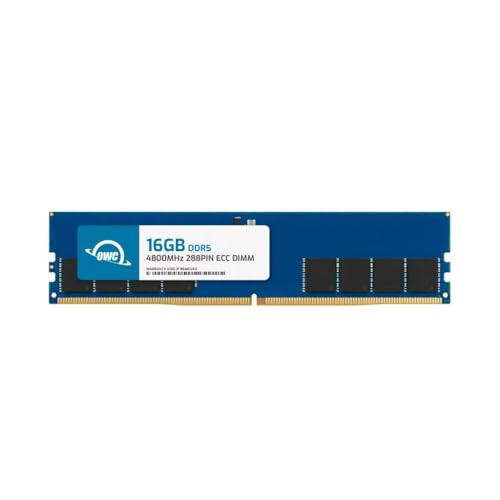
OWC 16GB DDR5 4800MHz ECC UDIMM
Best for: Workstation ECC memory upgrades
- Capacity
- 16GB
- Memory Speed
- 4800MHz
- CAS Latency
- CL40
- Kit Configuration
- 1 x 16GB
- Form Factor
- 288-pin UDIMM
- Voltage
- 1.1V
View on Amazon: OWC 16GB DDR5 4800MHz ECC UDIMM Affiliate link
This OWC module is a single 16GB DDR5 stick running at 4800MHz with ECC support. It uses a standard 288-pin UDIMM form factor and operates at 1.1V. The CL40 latency is standard for this speed tier. It suits workstations or servers needing reliable, error-correcting memory upgrades. You get a lifetime warranty and tech support, making it a safe choice for professional environments.
Pros
- ECC support for error correction
- Limited lifetime warranty included
- JEDEC-standard 4800MHz speed
- Free tech support provided
Cons
- Lower 4800MHz speed compared to gaming kits
- Single stick limits dual-channel performance
- Higher CL40 latency than high-performance options
Good fit if
- You need ECC memory for a workstation
- You require a single 16GB upgrade stick
- You want a lifetime warranty for peace of mind
Skip if
- You need high-speed gaming RAM above 6000MHz
- You want a matched dual-channel kit for best performance
- You are building a standard consumer desktop PC
Verdict: OWC 16GB DDR5 4800MHz ECC UDIMM is a solid choice for workstations requiring error correction. It fits users prioritizing reliability and warranty over raw speed.
Specifications side by side
| Spec | G.SKILL Trident Z5 Neo 64GB DDR5-6000 CL30 | OWC 16GB DDR5 4800MHz ECC UDIMM |
|---|---|---|
| Capacity | 64GB | 16GB |
| Memory Speed | 6000MT/s | 4800MHz |
| CAS Latency | CL30-40-40-96 | CL40 |
| Kit Configuration | 2x32GB | 1 x 16GB |
| Form Factor | 288-pin U-DIMM | 288-pin UDIMM |
| Overclocking Profile | AMD EXPO | not stated |
| Voltage | 1.40V | 1.1V |
| ECC Support | Non-ECC | ECC Unbuffered |
| Compatible Device | Desktop, PC | not stated |
| Size | 64GB | 16GB |
| Dimensions | 6.3 × 5.51 × 0.39 inches | not stated |
| Weight | 6.35 ounces | not stated |
| Color | Black | Black Chips |
| Model | F5-6000J3040G32GX2-TZ5N | OWC4E8D51R816GB-B922-SF |
Frequently asked questions
Is G.SKILL Trident Z5 Neo compatible with AMD EXPO?
Yes, this kit supports AMD EXPO profiles. It allows users to easily enable high-speed operation on compatible AMD platforms. The module is rated for 6000MHz with CL30 latency. This setup is ideal for desktops needing fast data rates for demanding tasks.
Does OWC DDR5 memory include error correction?
Yes, the OWC 16GB module features ECC support. Error correction helps maintain data integrity by detecting and fixing memory errors. This makes it a reliable choice for workstations that prioritize stability over raw speed. It runs at 4800MHz in a standard UDIMM form factor.
What is the capacity of the G.SKILL Trident Z5 Neo kit?
The G.SKILL Trident Z5 Neo kit provides 64GB of total memory. It typically comes as a dual-channel set of two 32GB modules. This high capacity suits users who need ample memory for intensive desktop workloads or large datasets.
Which RAM kit offers lower latency for gaming?
The G.SKILL Trident Z5 Neo offers lower latency with a CL30 timing. Lower latency can improve response times in gaming and intensive applications. The OWC module focuses on reliability rather than tight timings, making the G.SKILL option better for speed-focused builds.
Is the OWC memory suitable for standard desktop upgrades?
Yes, the OWC module uses the standard UDIMM form factor. It fits into standard desktop motherboard slots. While it runs at a modest 4800MHz, its ECC support makes it suitable for users needing reliability in a standard desktop or workstation environment.
How much does the G.SKILL kit weigh?
The G.SKILL Trident Z5 Neo kit weighs 6.35 ounces. This weight reflects the mass of the two modules including their heatspreaders. The dimensions are approximately 6.3 inches in length and 5.51 inches in width, fitting standard desktop cases without issue.
Can I use the OWC module for high-speed gaming?
The OWC module runs at 4800MHz, which is slower than gaming-focused kits. It is designed for workstations requiring error correction and stability. For high-speed gaming, the G.SKILL kit at 6000MHz with CL30 latency is a more appropriate choice for performance.