G.SKILL vs TEAMGROUP DDR4 RAMS: Which Brand Fits You?
As an Amazon Associate we earn from qualifying purchases. Links on this page are affiliate links.
This g skill vs TEAMGROUP ddr4 RAM comparison looks at two distinct desktop memory options. Both kits are non-ECC U-DIMMs designed for standard desktop PCs. The main difference lies in their performance targets and power efficiency. The G.SKILL Trident Z RGB offers higher speeds with RGB lighting, while the TEAMGROUP Elite focuses on lower voltage and standard JEDEC compliance. You need to decide if speed or efficiency matters more for your build.
Key differences
| Aspect | G.SKILL Trident Z RGB 16GB DDR4 RAM Kit | TEAMGROUP Elite 8GB DDR4 2666MHz UDIMM RAM |
|---|---|---|
| Memory Speed | Up to 3000MT/s | 2666MHz |
| CAS Latency | CL16 | CL19 |
| Voltage | 1.35V | 1.2V |
| Overclocking Profile | Intel XMP | Not listed |
| Kit Configuration | 2x8GB | 1x8GB |
Which one should you choose?
Choose G.SKILL Trident Z RGB 16GB DDR4 RAM Kit if
- You want higher memory speed for gaming or intensive tasks.
- You prefer a kit with RGB lighting for visual customization.
- You need a matched 2x8GB kit for dual-channel performance.
Choose TEAMGROUP Elite 8GB DDR4 2666MHz UDIMM RAM if
- You prioritize lower power consumption and heat output.
- You want strict JEDEC compliance for maximum stability.
- You are building a system that requires a single stick initially.
Verdict: Choose the G.SKILL Trident Z RGB if you need faster speeds and visual flair. Pick the TEAMGROUP Elite if you value lower voltage and standard JEDEC reliability. Both are solid non-ECC options for desktops.
G.SKILL vs TEAMGROUP DDR4 Specs
Memory Speed
The G.SKILL Trident Z RGB kit reaches up to 3000MT/s, while the TEAMGROUP Elite runs at 2666MHz. Higher speed generally means faster data transfer between your CPU and memory. This 334MT/s difference can matter in gaming or heavy workloads. You should note that the G.SKILL speed requires enabling an overclocking profile in your BIOS. The TEAMGROUP stick runs at its rated speed by default under JEDEC standards. If raw bandwidth is your priority, the G.SKILL option provides a clear performance head start.
Voltage Efficiency
Power consumption differs between these two modules. The TEAMGROUP Elite operates at a low working voltage of 1.2V. In contrast, the G.SKILL Trident Z RGB requires 1.35V to achieve its higher speeds. Lower voltage is better for system stability and heat management. It also reduces overall power draw from your desktop power supply. The TEAMGROUP design prioritizes energy efficiency and compliance with standard JEDEC specifications. The G.SKILL kit sacrifices some efficiency for increased performance. For users concerned with thermal output, the lower voltage of the TEAMGROUP module is a practical advantage.
CAS Latency
Latency measures the delay before data is accessed. The G.SKILL kit features a CAS Latency of CL16. The TEAMGROUP Elite has a higher latency of CL19. A lower number indicates faster response times from the memory. This difference of three cycles can impact system responsiveness in certain tasks. The G.SKILL module offers tighter timing for quicker data retrieval. The TEAMGROUP stick follows standard timing for its speed class. If you prioritize low latency for snappy performance, the G.SKILL CL16 rating is superior. This spec highlights the performance-oriented design of the G.SKILL product.
Overclocking Profile
Configuration options vary between the two kits. The G.SKILL Trident Z RGB includes an Intel XMP memory overclock profile. This allows you to easily boost speeds via BIOS settings. The TEAMGROUP Elite relies on standard JEDEC default profiles. It does not list specific XMP support in its published data. XMP simplifies achieving higher speeds without manual tuning. The G.SKILL kit is designed for users who want to customize performance. The TEAMGROUP module is plug-and-play for standard operation. If you plan to tweak your system for maximum speed, the G.SKILL XMP support is a key feature.
Kit Configuration
Capacity and channel configuration differ significantly. The G.SKILL product is a 16GB kit consisting of two 8GB sticks. This setup supports dual-channel mode for better bandwidth. The TEAMGROUP item is a single 8GB stick. It operates in single-channel mode unless paired with another identical module. Dual-channel memory provides a wider data path. The G.SKILL kit delivers double the total capacity out of the box. The TEAMGROUP stick offers flexibility to build up capacity later. For immediate performance and capacity, the G.SKILL dual-channel kit is the stronger choice.
Which G.SKILL or TEAMGROUP RAM fits you?
High-performance desktop gaming builds
The G.SKILL Trident Z RGB delivers up to 3000MT/s with CL16 latency. This higher speed and tighter timing improve data transfer rates for gaming and intensive tasks. It requires XMP activation in your BIOS to reach these specs, but offers superior performance for users prioritizing speed over power efficiency.
Standard office PC upgrades
The TEAMGROUP Elite runs at a standard 2666MHz with CL19 latency. It operates at a lower 1.2V, which reduces power consumption and heat. This kit is JEDEC compliant for plug-and-play stability without needing BIOS adjustments. It is ideal for everyday computing where maximum speed is not the primary goal.
Budget-conscious single-channel users
This single 8GB stick offers a cost-effective entry point for basic desktop needs. The 2666MHz speed is sufficient for web browsing and office applications. While it lacks the dual-channel potential of a matched kit, it provides reliable performance for users who need to expand memory capacity without upgrading to a faster, more expensive module.
The products compared

G.SKILL Trident Z RGB 16GB DDR4 RAM Kit
Best for: Desktop gaming and high-speed computing
- Total Capacity
- 16GB
- Memory Speed
- 3000MT/s
- CAS Latency
- CL16
- Voltage
- 1.35V
- Module Configuration
- 2x8GB
- Form Factor
- U-DIMM
View on Amazon: G.SKILL Trident Z RGB 16GB DDR4 RAM Kit Affiliate link
This G.SKILL kit offers 16GB of DDR4 memory in a 2x8GB configuration. It reaches speeds up to 3000MT/s with a CAS latency of CL16. The module runs at 1.35V and supports Intel XMP profiles. You get a high-performance option for desktop PCs that requires BIOS adjustments to achieve maximum speeds. It includes JEDEC defaults for stable booting.
Pros
- 16GB capacity in a 2x8GB kit configuration
- Speeds up to 3000MT/s with CL16 latency
- Supports Intel XMP for easy overclocking
- Runs at 1.35V for efficient power use
Cons
- Requires BIOS adjustments to reach maximum speed
- Non-ECC memory lacks error correction
- Mixing kits may cause system instability
Good fit if
- You need 16GB of desktop RAM
- You want high speeds up to 3000MT/s
- You are comfortable adjusting BIOS settings
Skip if
- You require ECC memory for stability
- You want plug-and-play speeds without tweaking
- You need more than 16GB total capacity
Verdict: G.SKILL Trident Z RGB 16GB DDR4 delivers fast 3000MT/s performance for desktop users who can manage BIOS settings. It suits gamers seeking high bandwidth, but those needing error correction should look elsewhere.
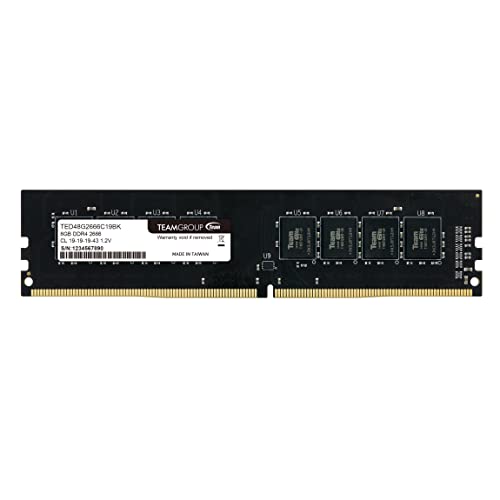
TEAMGROUP Elite 8GB DDR4 2666MHz UDIMM RAM
Best for: basic desktop memory upgrades
- Total Capacity
- 8GB
- Memory Speed
- 2666MHz
- CAS Latency
- CL19
- Voltage
- 1.2V
- Module Configuration
- 1x8GB
- Form Factor
- UDIMM
View on Amazon: TEAMGROUP Elite 8GB DDR4 2666MHz UDIMM RAM Affiliate link
This is a single 8GB stick of DDR4 memory running at 2666MHz. It uses standard 1.2V voltage and features CL19 latency. The module is a non-ECC UDIMM, making it suitable for standard desktop PCs. It complies with JEDEC specifications and holds QVL approval from motherboard manufacturers. This kit is designed for basic upgrades or single-channel configurations where high speed is not the priority.
Pros
- 8GB capacity in a single stick
- 2666MHz memory speed
- Standard 1.2V operating voltage
- JEDEC compliant and QVL approved
Cons
- Single-channel configuration limits bandwidth
- Lower 2666MHz speed compared to 3000MT/s options
- Higher CL19 latency than faster kits
Good fit if
- You need a budget-friendly single stick upgrade
- You are building a basic desktop PC
- You require JEDEC standard compatibility
Skip if
- You need dual-channel performance
- You want speeds above 2666MHz
- You require ECC memory support
Verdict: TEAMGROUP Elite DDR4 8GB 2666MHz is a solid choice for users needing a simple, compatible single-stick upgrade for standard desktops. It fits those prioritizing basic functionality over high-speed gaming performance.
Specifications side by side
| Spec | G.SKILL Trident Z RGB 16GB DDR4 RAM Kit | TEAMGROUP Elite 8GB DDR4 2666MHz UDIMM RAM |
|---|---|---|
| Total Capacity | 16GB | 8GB |
| Memory Speed | 3000MT/s | 2666MHz |
| CAS Latency | CL16 | CL19 |
| Voltage | 1.35V | 1.2V |
| Module Configuration | 2x8GB | 1x8GB |
| Form Factor | U-DIMM | UDIMM |
| ECC Support | Non-ECC | Non-ECC |
| Height | 1.7 inches | 1.97 inches |
| Compatible Device | Desktop, PC | Desktop, PC |
| Size | 16GB | 8GB Kit (1x8GB) |
| Dimensions | 5.2 × 0.67 × 1.7 inches | 5.91 × 3.94 × 1.97 inches |
| Weight | 4.8 ounces | 1.06 ounces |
| Color | Multicolor | Single Channel |
| Model | F4-3000C16D-16GTZR | TED48G2666C1901 |
Frequently asked questions
Is G.SKILL better than TEAMGROUP for gaming?
G.SKILL is better for gaming if you need higher bandwidth. The Trident Z RGB runs at 3000MT/s with CL16 latency. This speed helps data transfer faster than the TEAMGROUP Elite. TEAMGROUP runs at 2666MHz with CL19. You should choose G.SKILL for intensive gaming tasks.
Does TEAMGROUP DDR4 support ECC?
No, the TEAMGROUP Elite DDR4 does not support ECC. It is a Non-ECC module. This means it lacks error correction for data integrity. You should look elsewhere if your system requires ECC support for stability. This kit is designed for standard desktop compatibility instead.
What voltage does G.SKILL Trident Z RGB use?
The G.SKILL Trident Z RGB uses 1.35V. This is slightly higher than standard DDR4 voltage. Higher voltage supports its faster 3000MHz speed. You need to ensure your motherboard handles this power level. It is standard for high-performance gaming memory kits.
Is TEAMGROUP Elite good for basic upgrades?
Yes, TEAMGROUP Elite is good for basic upgrades. It offers 8GB capacity at 2666MHz. This fits users who need simple compatibility over high speed. It is a solid choice for standard desktops. You get reliable performance without the complexity of overclocking settings.
Can I use these RAM kits in laptops?
No, these kits are not for laptops. Both the G.SKILL and TEAMGROUP modules are UDIMM form factors. UDIMM stands for Unbuffered DIMM, designed for desktops. Laptops typically require SO-DIMM modules. You should check your device specifications before purchasing desktop memory.
What is the CAS latency of G.SKILL Trident Z?
The CAS latency is CL16. This timing indicates how long the RAM waits to respond to a command. Lower latency like CL16 offers faster response times. This complements its 3000MHz speed for gaming. TEAMGROUP uses CL19, which is slightly slower in timing.