Nemix RAM vs OLOy: DDR4 RAMS Compared by Specs
As an Amazon Associate we earn from qualifying purchases. Links on this page are affiliate links.
This guide compares Nemix RAM vs OLOy ddr4 RAM to help you choose the right memory for your system. Both modules use DDR4 technology and include a lifetime warranty. The main difference lies in their intended use. The Nemix kit is designed for servers with high capacity and error correction. The OLOy kit targets desktop gaming with higher speeds and RGB lighting. You must select based on your device type and performance needs.
Key differences
| Aspect | Nemix RAM 32GB DDR4 2133MHz ECC LRDIMM | OLOy Warhawk RGB 16GB (2x8GB) DDR4-3000 |
|---|---|---|
| Capacity | 32GB (1x32GB) | 16GB (2x8GB) |
| Memory Speed | 2133MHz | 3000MHz |
| Form Factor | LRDIMM | UDIMM |
| ECC Support | ECC | not listed |
| CAS Latency | not listed | CL16 |
| Voltage | 1.2V | 1.35V |
Which one should you choose?
Choose Nemix RAM 32GB DDR4 2133MHz ECC LRDIMM if
- You need maximum memory capacity for server workloads or virtualization.
- Your server motherboard requires LRDIMM modules for high-density configurations.
- You prioritize data integrity with ECC support for critical operations.
Choose OLOy Warhawk RGB 16GB (2x8GB) DDR4-3000 if
- You are building a desktop PC for gaming or general use.
- You want higher memory speeds to improve system responsiveness.
- Your motherboard supports UDIMM modules and XMP profiles for easy overclocking.
Verdict: Choose the Nemix RAM if you are upgrading a server that requires high-capacity LRDIMM modules with ECC protection. Select the OLOy kit if you are building or upgrading a desktop computer that benefits from higher speeds and standard UDIMM compatibility. Your choice depends entirely on whether your platform is a server or a desktop.
Specs: Server vs Desktop RAM
Memory Speed
The OLOy kit runs at 3000 MHz, which is significantly faster than the Nemix module. The Nemix RAM operates at 2133 MHz. Higher frequency generally allows for quicker data transfer between the memory and the processor. This speed difference is critical for gaming and high-performance desktop tasks. The Nemix speed is standard for older server platforms that prioritize stability and capacity over raw bandwidth. You will notice the OLOy speed is better for modern desktop applications. The Nemix speed is adequate for its specific server workload. This is a clear advantage for the OLOy kit in terms of raw performance metrics.
ECC Support
The Nemix RAM includes ECC support, while the OLOy kit does not list ECC capabilities. ECC, or Error Correction Code, detects and fixes memory errors automatically. This feature is vital for servers and workstations where data integrity is paramount. A single bit flip can cause system crashes or data corruption in critical applications. The OLOy UDIMM is designed for consumer desktops where this overhead is unnecessary. The Nemix LRDIMM ensures your server data remains safe from silent corruption. If you are running a database or virtualization server, this feature is essential. For gaming, this feature is irrelevant. The Nemix has the edge for professional reliability.
Form Factor
These two products use different physical connectors. The OLOy kit is a UDIMM, which is the standard for desktop computers. The Nemix RAM is an LRDIMM, designed for servers and high-end workstations. You cannot mix these types in the same system. LRDIMMs use a buffer to reduce the electrical load on the memory controller. This allows servers to support more memory modules per channel. UDIMMs connect directly to the controller with less buffering. Your motherboard must support the specific form factor. The OLOy fits standard desktop boards. The Nemix fits specific server boards. This is a fundamental compatibility difference, not a performance one. Each is correct for its intended platform.
Overclocking Profile
The OLOy kit supports Intel XMP 2.0 for automated overclocking. This allows your system to run at the rated 3000 MHz speed easily. You simply enable the profile in your BIOS. The Nemix RAM does not list XMP support. Server memory often runs at fixed, stable speeds to ensure maximum uptime. Overclocking is rarely a goal for server administrators. The OLOy profile makes it easy for desktop users to get full performance. The Nemix relies on standard JEDEC specifications. This makes the OLOy kit more user-friendly for desktop enthusiasts. The Nemix is designed for set-it-and-forget-it stability. The OLOy offers more control for desktop tuning.
Voltage
The Nemix RAM operates at 1.2V, which is the standard voltage for DDR4. The OLOy kit runs at 1.35V. Lower voltage typically means less power consumption and less heat generation. The Nemix 1.2V operation is efficient for servers that run 24/7. The OLOy 1.35V is common for high-performance desktop memory that pushes higher speeds. The higher voltage on the OLOy supports its 3000 MHz speed and lower latency. The Nemix voltage is sufficient for its 2133 MHz speed. For a desktop build, the OLOy voltage is normal for its class. For a server, the Nemix voltage is more efficient. This is a minor difference in efficiency versus performance.
Compatible Device
The Nemix RAM is listed for server use. The OLOy kit is listed for desktop use. This distinction is based on their form factor and features. The Nemix LRDIMM is built for high-capacity server environments. The OLOy UDIMM is built for consumer gaming and office desktops. You must choose the correct device type for your motherboard. The Nemix will not fit a standard desktop board. The OLOy will not fit a server board that requires LRDIMMs. This is the most important decision you will make. It determines which product is physically usable in your system. The Nemix is for servers. The OLOy is for desktops. This is a hard boundary for compatibility.
Choose the right RAM for your needs
Server administrators needing high capacity
You need maximum density for virtualization or databases. This 32GB LRDIMM lowers electrical load on the bus. It supports ECC for data integrity. The 1.2V voltage saves power. It fits high-DIMM-count server boards. Confirm your platform supports LRDIMM before buying. It posts correctly at full capacity.
Desktop gamers seeking speed
You want faster data transfer for gaming. This 16GB kit runs at 3000 MHz with CL16 latency. It uses 1.35V and supports Intel XMP 2.0 for easy overclocking. The UDIMM form factor fits standard desktop boards. It is compatible with both Intel and AMD processors. The RGB lighting adds visual appeal.
Workstations running 24/7 workloads
You require registered, ECC-protected operation for stability. The LRDIMM form factor allows high capacity per channel. It handles multi-socket workloads well. The 1.2V voltage is efficient for continuous use. It provides a lifetime replacement warranty. Ensure your server manual lists LRDIMM support. It is not for standard desktops.
The products compared

Nemix RAM 32GB DDR4 2133MHz ECC LRDIMM
Best for: Server virtualization and high-density workloads
- Total Capacity
- 32GB
- Memory Speed
- 2133MHz
- Voltage
- 1.2V
- Module Configuration
- 1x32GB
- Form Factor
- LRDIMM
- ECC Support
- ECC
View on Amazon: Nemix RAM 32GB DDR4 2133MHz ECC LRDIMM Affiliate link
This is a single 32GB DDR4-2133 module designed for servers and high-capacity workstations. It features ECC protection and a 1.2V operating voltage. The 288-pin LRDIMM form factor uses load-reduced buffering to lower electrical load on the memory bus. This allows high-DIMM-count boards to reach maximum capacity per channel. You need this for virtualization or in-memory databases where stability and density matter more than speed.
Pros
- 32GB single-stick capacity for high density
- ECC support for error correction
- LRDIMM buffering reduces bus load
- 1.2V standard voltage operation
Cons
- Only 2133MHz speed is slower than consumer DDR4
- Single stick kit limits dual-channel performance
- LRDIMM form factor is incompatible with standard desktops
Good fit if
- You run a server or workstation requiring ECC memory
- You need high capacity per channel for virtualization
- Your motherboard explicitly supports LRDIMM modules
Skip if
- You are building a standard desktop PC
- You need RGB lighting or aesthetic features
- You require speeds faster than 2133MHz
Verdict: Nemix RAM 32GB DDR4-2133 LRDIMM is a specialized server memory module for users who prioritize capacity and error correction over speed. It fits only systems that explicitly support LRDIMM technology.
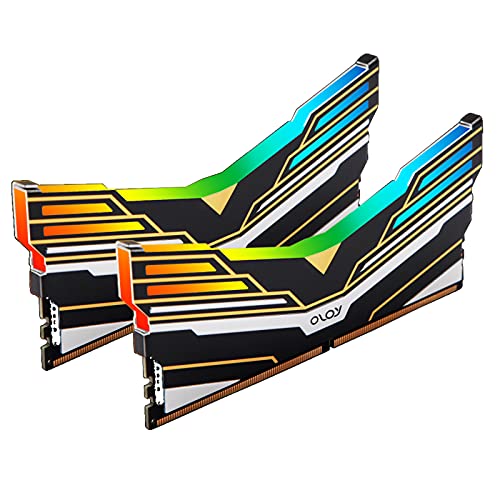
OLOy Warhawk RGB 16GB (2x8GB) DDR4-3000
Best for: Gaming builds needing 16GB and RGB lighting
- Total Capacity
- 16GB
- Memory Speed
- 3000MHz
- CAS Latency
- CL16
- Voltage
- 1.35V
- Module Configuration
- 2x8GB
- Form Factor
- UDIMM
View on Amazon: OLOy Warhawk RGB 16GB (2x8GB) DDR4-3000 Affiliate link
This OLOy kit gives you 16GB of DDR4 memory in a 2x8GB configuration. It runs at 3000 MHz with CL16 latency at 1.35V. The module supports Intel XMP 2.0 for automated overclocking. It fits standard desktop motherboards with 288-pin slots. The black heatspreader includes Aura Sync RGB lighting. It works with both Intel and AMD platforms.
Pros
- 3000 MHz speed with CL16 latency
- 16GB total capacity via 2x8GB modules
- Intel XMP 2.0 support for easy overclocking
- Compatible with Intel and AMD systems
Cons
- 16GB capacity is lower than the 32GB option on this list
- Requires 1.35V, which is higher than the 1.2V standard
- Only includes Aura Sync RGB without app control details
Good fit if
- You need 16GB of RAM for standard gaming
- You want XMP 2.0 for simple speed boosts
- You prefer RGB lighting on your memory
Skip if
- You require 32GB of memory capacity
- You need the lowest possible voltage at 1.2V
- You are building an ECC server system
Verdict: OLOy Warhawk 16GB DDR4 3000MHz offers solid gaming performance with XMP support. It fits users who want RGB lighting and standard 16GB capacity for desktop builds.
Specifications side by side
| Spec | Nemix RAM 32GB DDR4 2133MHz ECC LRDIMM | OLOy Warhawk RGB 16GB (2x8GB) DDR4-3000 |
|---|---|---|
| Total Capacity | 32GB | 16GB |
| Memory Speed | 2133MHz | 3000MHz |
| CAS Latency | not stated | CL16 |
| Voltage | 1.2V | 1.35V |
| Module Configuration | 1x32GB | 2x8GB |
| Form Factor | LRDIMM | UDIMM |
| ECC Support | ECC | not stated |
| Height | not stated | 0.26 inches |
| Compatible Device | Server | Desktop |
| Dimensions | 6 × 0.5 × 0.5 inches | 5.63 × 2.4 × 0.26 inches |
| Weight | 4 ounces | 1.72 ounces |
| Size | 32GB (1X32GB) DDR4 2133MHZ LRDIMM | 8GBx2 |
| Color | 32GB | Black |
| Model | ML17000-344K01-106 | MD4U083016BEDA |
Frequently asked questions
Can I use the OLOy Warhawk in a server?
No, the OLOy Warhawk is designed for desktop computers. It uses a UDIMM form factor, which is standard for consumer PCs. Servers typically require specific module types like LRDIMM or RDIMM for stability and higher capacity. Using desktop RAM in a server may cause compatibility issues or prevent the system from booting properly.
Does the Nemix RAM support error correction?
Yes, the Nemix RAM 32GB module includes ECC support. Error Correction Code helps detect and fix data corruption, which is critical for server environments. This feature ensures data integrity during high-density workloads like virtualization. The OLOy Warhawk does not list ECC support, making it less suitable for tasks requiring strict data accuracy.
What is the voltage difference between these kits?
The Nemix RAM operates at 1.2V, while the OLOy Warhawk runs at 1.35V. Lower voltage generally means better power efficiency and less heat generation. The Nemix module is optimized for server power savings. The OLOy kit uses higher voltage to support its higher speed and RGB lighting features in desktop builds.
Is the Nemix RAM compatible with standard desktop PCs?
Likely not, as the Nemix RAM is an LRDIMM module. LRDIMM technology is specialized for servers that explicitly support this form factor. Standard desktop motherboards usually accept UDIMM modules. The OLOy Warhawk uses UDIMM, making it the correct choice for typical desktop computers rather than the server-focused Nemix option.
Which RAM is better for gaming performance?
The OLOy Warhawk is better for gaming. It runs at 3000 MHz, which is significantly faster than the Nemix RAM’s 2133 MHz. Higher memory speed allows for quicker data transfer between the processor and memory. The OLOy kit also includes RGB lighting, which many gamers prefer for aesthetic builds.
What form factor does each RAM kit use?
The Nemix RAM uses the LRDIMM form factor, designed for server motherboards. The OLOy Warhawk uses the UDIMM form factor, which is standard for desktop computers. LRDIMM modules handle higher capacities with lower electrical load. UDIMM modules are common in consumer PCs and offer easier compatibility with standard desktop hardware.