SODIMM vs RDIMM DDR5 RAMs in 2026: Key Differences
As an Amazon Associate we earn from qualifying purchases. Links on this page are affiliate links.
This guide compares SODIMM vs RDIMM ddr5 RAM options for different computing needs. Both kits share a 4800MHz speed and CL40 latency. They use DDR5 technology for modern performance. The main difference lies in their physical design and target hardware. One is built for compact laptops, while the other serves enterprise servers. You will see how form factor and error correction change their use cases.
Key differences
| Aspect | ADATA Premier 16GB DDR5 4800MHz SODIMM | Nemix RAM 256GB DDR5 4800MHz ECC RDIMM Kit |
|---|---|---|
| Form Factor | 262-Pin SODIMM | 288-Pin RDIMM |
| Capacity | 16GB | 256GB |
| ECC Support | On-Die Error Correcting Code | Registered ECC |
| Compatible Device | Laptops | Servers |
| Voltage | Not listed | 1.1V |
Which one should you choose?
Choose ADATA Premier 16GB DDR5 4800MHz SODIMM if
- You need memory for a laptop or small form factor PC
- You require a lower total capacity like 16GB
- You want On-Die ECC for standard error correction
Choose Nemix RAM 256GB DDR5 4800MHz ECC RDIMM Kit if
- You are building or upgrading a server system
- You need high capacity kits up to 256GB
- You require Registered ECC for enterprise stability
Verdict: Choose the ADATA Premier if you are upgrading a laptop or compact desktop. Select the Nemix RAM kit for server environments that demand high capacity and registered error correction. Your choice depends entirely on whether your device uses SODIMM or RDIMM slots.
SODIMM vs RDIMM DDR5 Comparison
Form Factor
The ADATA Premier uses a 262-pin SODIMM form factor, designed for compact systems like laptops and small form-factor PCs. This smaller footprint allows it to fit into tight spaces where standard desktop memory cannot. In contrast, the Nemix RAM kit utilizes a 288-pin RDIMM. This registered DIMM is physically larger and intended for desktop workstations and server racks. The pin count difference ensures you cannot accidentally install the wrong type of memory into an incompatible slot, protecting your hardware from physical damage during installation.
Capacity
Capacity is a major differentiator between these two kits. The ADATA Premier offers a single stick of 16GB, which is typical for upgrading a single laptop slot or a small system. This is sufficient for general computing tasks. The Nemix RAM kit provides a massive 256GB total capacity, configured as eight 32GB sticks. This high density is necessary for enterprise servers handling large datasets or virtualization. If you need to run multiple heavy applications simultaneously, the Nemix kit provides the necessary headroom, while the ADATA stick is limited to basic multitasking.
ECC Support
Error correction capabilities differ significantly between these modules. The ADATA Premier features On-Die Error Correcting Code. This helps maintain data integrity at the chip level but does not offer the full system-level protection of registered ECC. The Nemix RAM kit includes Registered ECC. This architecture uses a buffer to stabilize signals and correct single-bit errors on the fly. This is critical for server environments where data corruption can cause crashes. For a laptop, the ADATA solution is adequate, but for mission-critical servers, the Nemix Registered ECC is superior.
Voltage
Power efficiency is specified by operating voltage. The Nemix RAM kit operates at 1.1V, which is the standard low-voltage requirement for DDR5 memory. This helps reduce heat and power consumption in densely populated server racks. The ADATA Premier does not list a specific voltage in its key specs, though DDR5 SODIMMs typically run at similar low voltages. The Nemix kit explicitly highlights its 1.1V operation as part of its precise matching for server memory controllers. This transparency helps administrators plan power budgets more accurately for their infrastructure.
Compatible Device
These kits are designed for entirely different classes of hardware. The ADATA Premier SODIMM is built for portable computers and compact desktops. It fits into the smaller memory slots found in laptops and mini-PCs. The Nemix RAM kit is explicitly compatible with enterprise servers, including Sapphire Rapids, Xeon Scalable, ProLiant, and Supermicro systems. It is not designed for consumer laptops. You must choose the ADATA option for mobile computing and the Nemix option for stationary, high-performance server infrastructure.
Which DDR5 Kit Fits Your System
Laptop and small form factor users
You need the 262-pin SODIMM form factor to fit compact devices like laptops. This 16GB kit runs at 4800MHz with CL40 latency. It includes a Power Management IC for better energy efficiency. The On-Die ECC helps maintain data integrity in portable systems without requiring registered buffers.
Server administrators needing high capacity
Your server requires the 288-pin RDIMM form factor for enterprise stability. This 256GB kit uses registered memory to offload the memory controller. The ECC support corrects single-bit errors to prevent silent data corruption. It is spec-matched for Sapphire Rapids and Xeon Scalable processors to ensure full capacity recognition.
Desktop PC builders with standard slots
Standard desktop motherboards typically use 288-pin DIMMs. This RDIMM kit provides 256GB of capacity in an 8x32GB configuration. It operates at 1.1V and 4800MHz with CL40 latency. The registered architecture ensures compatibility with systems that support registered ECC memory, offering greater stability than unbuffered modules.
Quick picks
| # | Product | Best for | Price |
|---|---|---|---|
| 1 | ADATA Premier 16GB DDR5 4800MHz SODIMM | Laptop memory upgrades | Check price of ADATA Premier 16GB DDR5 4800MHz SODIMM on Amazon |
| 2 | Nemix RAM 256GB DDR5 4800MHz ECC RDIMM Kit | Enterprise servers needing 256GB capacity | Check price of Nemix RAM 256GB DDR5 4800MHz ECC RDIMM Kit on Amazon |
The products compared

ADATA Premier 16GB DDR5 4800MHz SODIMM
Best for: Laptop memory upgrades
- Form Factor
- SODIMM (what this guide is about)
- Capacity
- 16GB
- Memory Speed
- 4800MHz
- CAS Latency
- CL40
- Kit Configuration
- 1x16GB
- ECC Support
- On-Die Error Correcting Code
View on Amazon: ADATA Premier 16GB DDR5 4800MHz SODIMM Affiliate link
This is a 16GB DDR5 SODIMM module running at 4800MHz with CL40 latency. It uses a 262-pin form factor designed for laptops and small form-factor PCs. The kit includes an on-die error correcting code for data integrity and a built-in power management IC for efficiency. It is a single stick configuration, ideal for upgrading systems that require compact memory modules.
Pros
- 4800MHz memory speed
- 262-pin SODIMM form factor
- On-die error correcting code
- Built-in power management IC
Cons
- Single stick configuration limits dual-channel bandwidth
- 16GB capacity is lower than the 256GB RDIMM option
- CL40 latency is standard for this speed tier
Good fit if
- You need to upgrade a laptop with a 262-pin slot
- You require DDR5 speeds for modern mobile processors
- You want a single module for basic system expansion
Skip if
- You need high-capacity server memory like 256GB
- You are building a desktop PC with DIMM slots
- You require dual-channel performance from a single stick
Verdict: ADATA 16GB DDR5 SODIMM 4800MHz fits users upgrading laptops or compact systems who need reliable DDR5 performance without the bulk of server-grade memory.
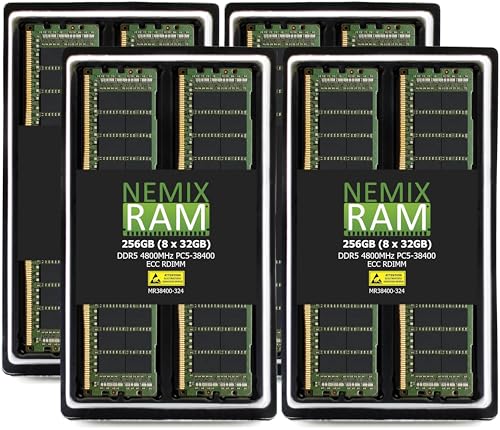
Nemix RAM 256GB DDR5 4800MHz ECC RDIMM Kit
Best for: Enterprise servers needing 256GB capacity
- Form Factor
- RDIMM (what this guide is about)
- Capacity
- 256GB
- Memory Speed
- 4800MHZ
- CAS Latency
- CL40
- Kit Configuration
- 8X32GB
- Voltage
- 1.1V
View on Amazon: Nemix RAM 256GB DDR5 4800MHz ECC RDIMM Kit Affiliate link
This is a 256GB DDR5 server memory kit featuring eight 32GB modules. It runs at 4800MHz with CL40 latency and uses 288-pin RDIMM form factor. The kit includes Registered ECC to correct single-bit errors. It operates at 1.1V. This setup suits enterprise servers needing high capacity and stability. It matches Sapphire Rapids and Xeon Scalable requirements.
Pros
- 256GB total capacity across eight 32GB sticks
- Registered ECC corrects single-bit errors
- 4800MHz speed with CL40 latency
- 1.1V operating voltage
- 288-pin RDIMM form factor
Cons
- Only compatible with server motherboards
- High capacity requires specific population rules
- No consumer desktop compatibility
Good fit if
- You need 256GB of server RAM
- You run Sapphire Rapids or Xeon Scalable systems
- You require ECC error correction
Skip if
- You build standard desktop PCs
- You need SODIMM form factor
- You want lower latency than CL40
Verdict: Nemix RAM 256GB DDR5 4800MHz RDIMM fits enterprise servers requiring large memory pools. It delivers stability through registered ECC for critical workloads.
Specifications side by side
| Spec | ADATA Premier 16GB DDR5 4800MHz SODIMM | Nemix RAM 256GB DDR5 4800MHz ECC RDIMM Kit |
|---|---|---|
| Capacity | 16GB | 256GB |
| Memory Speed | 4800MHz | 4800MHZ |
| CAS Latency | CL40 | CL40 |
| Kit Configuration | 1x16GB | 8X32GB |
| Form Factor | 262-Pin SODIMM | 288-PIN RDIMM |
| Voltage | not stated | 1.1V |
| ECC Support | On-Die Error Correcting Code | Registered ECC |
| Compatible Device | not stated | Server |
| Dimensions | 23.6 × 23.6 × 33.5 inches | not stated |
| Weight | 0.71 ounces | not stated |
| Size | 16GB(1x16GB) | 256GB (8X32GB) DDR5 4800MHZ RDIMM |
| Color | 4800MHz | Black |
| Model | AD5S480016G-S | not stated |
Frequently asked questions
Can I install an RDIMM in a laptop?
No, you cannot install an RDIMM in a laptop. Laptops require the smaller SODIMM form factor, such as the ADATA Premier kit. RDIMMs are designed for server motherboards with specific slots. The physical dimensions and pin layouts differ significantly between the two types. Using the wrong module will prevent your system from booting or cause hardware damage.
Does DDR5 SODIMM support ECC?
The ADATA Premier SODIMM does not list ECC support in its specifications. It focuses on standard performance for consumer devices. In contrast, the Nemix RDIMM explicitly includes ECC capabilities. This error correction is vital for server stability. If you need ECC in a compact form, you must verify specific manufacturer data, as standard SODIMMs often omit it.
What is the main speed difference between these kits?
There is no speed difference between these specific kits. Both the ADATA SODIMM and the Nemix RDIMM operate at 4800MHz. They also share a CL40 CAS latency rating. This means data access timing is identical for both modules. The performance gap comes from their intended use cases rather than raw clock speed differences.
Is 16GB enough for a server upgrade?
A single 16GB stick is rarely sufficient for modern enterprise servers. The Nemix kit offers 256GB total capacity in an 8x32GB configuration. This high density supports large memory pools for critical workloads. The ADATA 16GB SODIMM is designed for individual laptops. You should choose the RDIMM kit for server environments requiring substantial data handling.
Why do servers use RDIMM instead of SODIMM?
Servers use RDIMM for stability and high capacity. The registered design buffers memory commands, reducing electrical load on the CPU. This allows for more sticks and larger total memory, like the 256GB Nemix kit. SODIMMs prioritize small size for laptops. They lack the registered buffering needed for large-scale enterprise data processing tasks.
Can I mix SODIMM and RDIMM in one system?
You cannot mix SODIMM and RDIMM modules in the same system. They have different physical footprints and electrical requirements. A motherboard is designed for one specific form factor. The ADATA SODIMM fits laptops, while the Nemix RDIMM fits servers. Mixing types is physically impossible and electronically incompatible with any standard motherboard.