TEAMGROUP Elite 32GB (2x16GB) DDR5 vs TEAMGROUP T-Force Delta RGB DDR5: Spec Comparison
As an Amazon Associate we earn from qualifying purchases. Links on this page are affiliate links.
You are comparing the teamgroup elite 32gb 2x16gb ddr5 vs t force delta RGB ddr5. Both kits offer 32GB of capacity in a 2x16GB configuration for desktop systems. The primary difference lies in performance targets. The Elite model focuses on standard JEDEC speeds with on-die ECC for stability. The T-Force Delta RGB targets high-speed overclocking with XMP 3.0 profiles. You should check your motherboard compatibility before purchasing either option.
Key differences
| Aspect | TEAMGROUP Elite 32GB (2x16GB) DDR5 4800MHz UDIMM Kit | TEAMGROUP T-Force Delta RGB DDR5 32GB 7200MHz |
|---|---|---|
| Memory Speed | 4800MHz | 7200MHz |
| CAS Latency | CL40 | CL34 |
| Overclocking Profile | Not listed | XMP 3.0 |
| ECC Support | On-die ECC | Not listed |
| Voltage | 1.1V | Not listed |
Which one should you choose?
Choose TEAMGROUP Elite 32GB (2x16GB) DDR5 4800MHz UDIMM Kit if
- You need standard JEDEC speeds with on-die ECC for stability.
- You prefer a lower voltage specification of 1.1V.
- You want a kit with a listed lifetime warranty.
Choose TEAMGROUP T-Force Delta RGB DDR5 32GB 7200MHz if
- You require high memory speeds up to 7200MHz.
- You plan to use XMP 3.0 profiles for overclocking.
- You prioritize lower CAS latency of CL34.
Verdict: Choose the Elite if you prioritize stability and standard speeds with on-die ECC. Select the T-Force Delta RGB if you need high-speed performance and overclocking capabilities via XMP 3.0. Your motherboard compatibility should dictate this choice.
Speed and Latency Comparison
Memory Speed
The T-Force Delta RGB operates at 7200MHz, offering significantly higher bandwidth than the Elite kit. The Elite model runs at a base JEDEC speed of 4800MHz. Higher frequencies generally improve data throughput for demanding tasks. You will see a clear performance gap here. The Delta RGB is designed for high-speed applications. The Elite kit targets standard compatibility and stability. If raw speed is your priority, the Delta RGB has the advantage.
CAS Latency
Latency affects how quickly the memory responds to commands. The T-Force Delta RGB features a CAS Latency of CL34. The Elite kit has a higher CAS Latency of CL40. Lower numbers indicate faster response times. This means the Delta RGB can process data with less delay. The Elite kit prioritizes stability at standard voltages. For users needing tighter timings, the Delta RGB is superior. The difference is measurable in performance benchmarks.
ECC Support
Error Correction Code (ECC) helps maintain data integrity. The Elite kit includes on-die ECC, which self-corrects DRAM cells for stability. The Delta RGB does not list on-die ECC support in its specifications. On-die ECC is valuable for workstations and systems requiring high reliability. The Elite kit offers this protection out of the box. The Delta RGB relies on standard error handling. If data stability is critical, the Elite kit has an edge.
Overclocking Profile
Overclocking profiles allow you to run memory faster than its base speed. The T-Force Delta RGB supports XMP 3.0 profiles. The Elite kit does not list specific XMP support in its data. XMP 3.0 simplifies the process of enabling higher speeds on compatible motherboards. This makes the Delta RGB easier to optimize for performance. The Elite kit runs at its specified JEDEC speed by default. For enthusiasts who want to tweak settings, the Delta RGB is more flexible.
Operating Voltage
Voltage impacts power consumption and heat generation. The Elite kit operates at 1.1V, which is the standard voltage for DDR5. The Delta RGB does not list its specific operating voltage in the provided data. Standard voltage helps ensure compatibility with a wide range of motherboards. The Elite kit is guaranteed to run at this efficient level. You should check the Delta RGB specifications for its voltage requirements. The Elite kit offers a clear advantage in known power efficiency.
Which RAM kit fits your build
Users needing high speed for gaming
The T-Force Delta RGB runs at 7200MHz with CL34 latency. This higher frequency and tighter timing provide greater bandwidth for demanding applications like video editing and gaming. It supports XMP 3.0 for easy configuration. You get faster data throughput compared to standard speeds.
Users prioritizing stability and standard speeds
The Elite kit operates at a base JEDEC speed of 4800MHz. It includes on-die ECC to self-correct DRAM cells, ensuring system stability. The 1.1V voltage reduces power usage. You benefit from a reliable, non-ECC UDIMM design that focuses on consistent performance for general desktop tasks.
Users wanting standard compatibility without overclocking
This model uses standard JEDEC specifications, making it compatible with a wide range of motherboards without requiring manual tuning. The 4800MHz speed is sufficient for most everyday computing needs. You avoid the complexity of XMP profiles while still getting 32GB of capacity in a dual-channel configuration.
The products compared

TEAMGROUP Elite 32GB (2x16GB) DDR5 4800MHz UDIMM Kit
Best for: budget desktop builds needing stable DDR5
- Capacity
- 32GB
- Memory Speed
- 4800MHz
- CAS Latency
- CL40
- Kit Configuration
- 2x16GB
- Form Factor
- 288 Pin UDIMM
- Voltage
- 1.1V
View on Amazon: TEAMGROUP Elite 32GB (2x16GB) DDR5 4800MHz UDIMM Kit Affiliate link
This TEAMGROUP Elite kit offers 32GB of DDR5 memory in a 2x16GB configuration. It runs at 4800MHz with CL40 latency and operates at 1.1V. The module includes On-die ECC for stability and uses a standard UDIMM form factor. It suits users seeking reliable baseline performance for desktop PCs without the premium cost of higher speeds or RGB lighting.
Pros
- 32GB capacity (2x16GB) for solid multitasking
- On-die ECC for data stability
- Low 1.1V operating voltage
- Standard UDIMM form factor fits most boards
Cons
- 4800MHz speed is slower than competitors
- CL40 latency is higher than faster kits
- No RGB lighting or heatsink design
Good fit if
- You need reliable, stable memory for daily tasks
- You are building a budget-friendly desktop PC
- You prioritize capacity over high clock speeds
Skip if
- You require high-speed gaming performance above 5600MHz
- You want aesthetic RGB lighting effects
- You need overclocking headroom for extreme speeds
Verdict: TEAMGROUP Elite 32GB DDR5 4800MHz provides stable, entry-level DDR5 performance for users who value reliability and capacity over speed or aesthetics.
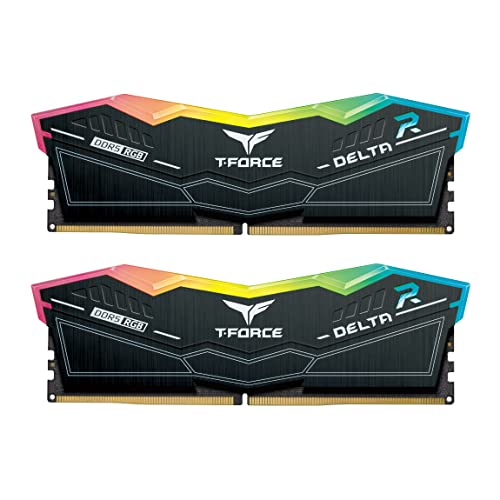
TEAMGROUP T-Force Delta RGB DDR5 32GB 7200MHz
Best for: RGB gaming and high-performance desktops
- Capacity
- 32GB
- Memory Speed
- 7200MHz
- CAS Latency
- CL34
- Kit Configuration
- 2x16GB
- Overclocking Profile
- XMP 3.0
- Compatible Device
- Desktop
View on Amazon: TEAMGROUP T-Force Delta RGB DDR5 32GB 7200MHz Affiliate link
This 32GB DDR5 kit offers 7200MHz speed with CL34 latency. It uses XMP 3.0 for easy overclocking and features A-DIE chips for stability. The black heatsink includes RGB lighting. It suits desktop users needing high bandwidth for gaming or video editing. You get 16GB per stick in a dual-channel configuration.
Pros
- 7200MHz memory speed
- CL34 CAS latency
- XMP 3.0 support
- A-DIE chips
Cons
- RGB lighting requires motherboard sync
- No included software for color control
- Higher latency than non-RGB kits
Good fit if
- You want high-speed DDR5 for gaming
- You need RGB lighting for your build
- You prefer A-DIE memory chips
Skip if
- You need silent operation without LEDs
- You want the lowest possible latency
- You are building a compact mini-ITX PC
Verdict: TEAMGROUP T-Force Delta RGB DDR5 32GB delivers top-tier speed for enthusiasts who value aesthetics and performance. It is ideal for gamers and content creators who want visible RGB lighting and high bandwidth.
Specifications side by side
| Spec | TEAMGROUP Elite 32GB (2x16GB) DDR5 4800MHz UDIMM Kit | TEAMGROUP T-Force Delta RGB DDR5 32GB 7200MHz |
|---|---|---|
| Capacity | 32GB | 32GB |
| Memory Speed | 4800MHz | 7200MHz |
| CAS Latency | CL40 | CL34 |
| Kit Configuration | 2x16GB | 2x16GB |
| Form Factor | 288 Pin UDIMM | not stated |
| Overclocking Profile | not stated | XMP 3.0 |
| Voltage | 1.1V | not stated |
| ECC Support | Non-ECC, On-die ECC | not stated |
| Compatible Device | Desktop, PC | Desktop |
| Size | 32GB | 32GB(2x16GB) |
| Dimensions | 5.91 × 50 × 30.3 inches | 19.7 × 19.7 × 11 inches |
| Weight | 0.53 ounces | 4.97 ounces |
| Color | Dual Channel | Black |
| Model | TED532G4800C40DC01 | FF3D532G7200HC34ADC01 |
Frequently asked questions
Can I use the T-Force Delta RGB 7200MHz kit on a motherboard that only supports up to 4800MHz?
Yes, you can install the higher-speed kit, but it will run at the maximum speed your motherboard supports. The T-Force Delta RGB is backward compatible with lower speeds. If your board caps out at 4800MHz, both kits will perform similarly in terms of raw frequency. You will not gain the 7200MHz benefit unless your platform allows it.
Does the Elite DDR5 kit come with an RGB heatspreader?
No, the Elite kit does not feature RGB lighting. It uses a standard black heatspreader design focused on thermal efficiency rather than aesthetics. The T-Force Delta RGB includes visible lighting effects for your build. If you prefer a clean look without LEDs, the Elite is the straightforward choice.
What is the CAS latency for the T-Force Delta RGB 7200MHz kit?
The T-Force Delta RGB kit has a CAS latency of CL34. This timing is specified for its 7200MHz speed. In contrast, the Elite kit runs at CL40 for its 4800MHz speed. Lower latency can improve responsiveness in certain gaming and productivity scenarios.
Is ECC support available on either of these TEAMGROUP DDR5 kits?
Neither kit supports ECC. Both the Elite and T-Force Delta RGB are Non-ECC modules designed for standard desktop PCs. ECC memory is typically reserved for workstations and servers. For gaming or general desktop use, Non-ECC is the standard and expected configuration.
Which kit is lighter and easier to handle during installation?
The Elite kit is significantly lighter, weighing only 0.53 ounces. The T-Force Delta RGB weighs 4.97 ounces due to its larger heatspreader and RGB components. The Elite’s lighter weight makes it slightly easier to maneuver into tight slots. The Delta’s extra mass comes from its aesthetic hardware.
Can I mix these two kits in the same system for 64GB total?
You should not mix these kits. They have different speeds and timings. The Elite runs at 4800MHz with CL40, while the Delta runs at 7200MHz with CL34. Mixing them forces the system to run both sticks at the speed of the slower kit. This can cause stability issues or reduced performance.
What is the form factor for these memory kits?
The Elite kit uses the standard UDIMM form factor. This is the typical stick shape for desktop motherboards. The T-Force Delta RGB is also designed for desktops. Both kits fit into standard DIMM slots on modern ATX and micro-ATX boards. They are not for laptops or SODIMM slots.