TEAMGROUP Elite 32GB (2x16GB) DDR5 or TEAMGROUP T-Force Vulcan 32GB DDR5-6000? Which TEAMGROUP Model to Buy
As an Amazon Associate we earn from qualifying purchases. Links on this page are affiliate links.
You are comparing the teamgroup elite 32gb 2x16gb ddr5 vs t force vulcan 32gb ddr5 6000. Both kits offer 32GB of capacity in a 2x16GB configuration for desktop PCs. They share the same brand but target different performance needs. The main difference lies in their speed and timing. One runs at a standard JEDEC baseline, while the other offers higher frequencies with an overclocking profile. You should review the specs below to see which fits your motherboard and usage.
Key differences
| Aspect | TEAMGROUP Elite 32GB (2x16GB) DDR5 4800MHz UDIMM Kit | TEAMGROUP T-Force Vulcan 32GB DDR5-6000 CL38 |
|---|---|---|
| Memory Speed | 4800MHz | 6000MHz |
| CAS Latency | CL40 | CL38 |
| Overclocking Profile | Not listed | XMP 3.0 |
| ECC Support | Non-ECC, On-die ECC | Not listed |
| Voltage | 1.1V | Not listed |
Which one should you choose?
Choose TEAMGROUP Elite 32GB (2x16GB) DDR5 4800MHz UDIMM Kit if
- You need a plug-and-play solution that works with standard JEDEC speeds without manual configuration.
- You prioritize energy efficiency and a lower operating voltage of 1.1V.
- You value the stability provided by built-in On-die ECC for self-correcting DRAM cells.
Choose TEAMGROUP T-Force Vulcan 32GB DDR5-6000 CL38 if
- You want higher memory bandwidth for gaming or content creation at 6000MHz.
- You prefer tighter timings with a CL38 latency for better responsiveness.
- You plan to enable XMP 3.0 profiles for easy performance tuning on compatible motherboards.
Verdict: Choose the Elite if you want reliable, low-voltage operation straight out of the box. Pick the T-Force Vulcan if you need higher speeds and lower latency for performance tasks. Your motherboard compatibility and desired speed will dictate the best choice.
Speed and Latency Comparison
Memory speed
The TEAMGROUP Elite operates at a base speed of 4800MHz. This is the standard JEDEC speed for this kit. The T-Force Vulcan runs at 6000MHz. This is a significant increase in bandwidth. Faster memory helps with data transfer rates in demanding tasks. You will see better performance with the Vulcan in high-load scenarios. The Elite is sufficient for basic desktop use. The Vulcan is better for gaming and content creation. Higher MHz means more data processed per second. This makes the Vulcan the clear choice for speed.
CAS latency
Latency affects how quickly the RAM responds to commands. The Elite has a CAS Latency of CL40. The Vulcan has a lower CAS Latency of CL38. A lower number is better for responsiveness. The Vulcan reacts faster to system requests. This reduces lag in tight loops. The Elite is slightly slower to respond. The difference is measurable in benchmark tests. You get better timing with the Vulcan. This makes it more efficient for intensive applications. The lower latency gives the Vulcan an edge.
Overclocking profile
The Vulcan includes an XMP 3.0 profile. This allows you to easily enable the higher 6000MHz speed. It simplifies setup in your BIOS. The Elite data does not list an XMP profile. It runs at its base 4800MHz JEDEC speed. You do not need to configure anything for the Elite. However, you also cannot boost its speed easily. The Vulcan offers flexibility for enthusiasts. You can optimize performance with one click. The Elite is plug-and-play but static. The Vulcan provides more control over your system.
ECC support
The Elite features On-die ECC. This self-corrects DRAM cells for stability. It helps prevent data corruption during operation. The Vulcan data does not mention On-die ECC. It focuses on power management ICs for stability. The Elite is better for data integrity. It adds a layer of protection. The Vulcan relies on other methods for reliability. If you need extra error correction, the Elite is suitable. The Vulcan is designed for performance rather than correction. This feature is unique to the Elite in this comparison.
Voltage
The Elite runs at 1.1V. This is the standard voltage for DDR5. It ensures energy efficiency and compatibility. The Vulcan data does not specify its operating voltage. We cannot compare this aspect directly. Both kits are designed for standard desktop power supplies. The Elite has a known low power draw. The Vulcan likely uses similar voltage standards. You do not need to worry about power issues. Both should work in standard systems. The Elite has a listed advantage here.
Which TEAMGROUP DDR5 Kit Fits You
Users prioritizing maximum speed and low latency
The T-Force Vulcan offers a higher memory speed of 6000MHz compared to the Elite's 4800MHz. It also features a tighter CAS latency of CL38. This combination provides faster data transfer rates and reduced access times. The XMP 3.0 profile ensures easier setup for these enhanced performance settings on compatible motherboards.
Buyers seeking baseline stability and on-die error correction
The Elite kit includes JEDEC on-die ECC, which self-corrects DRAM cells for improved data integrity. It runs at the standard 4800MHz speed with CL40 latency. This configuration prioritizes system stability and energy efficiency through its 1.1V operating voltage. It is a reliable choice for users who value consistent performance over raw speed.
Owners of older or basic DDR5 motherboards
The Elite operates at 4800MHz, which is a widely supported JEDEC standard speed. This ensures compatibility with a broader range of motherboards without requiring complex BIOS updates or XMP profiles. The CL40 latency is standard for this speed tier. This kit provides a plug-and-play experience for systems that may not support higher frequencies.
The products compared

TEAMGROUP Elite 32GB (2x16GB) DDR5 4800MHz UDIMM Kit
Best for: Standard desktop builds needing stable 32GB DDR5
- Capacity
- 32GB
- Memory Speed
- 4800MHz
- CAS Latency
- CL40
- Kit Configuration
- 2x16GB
- Form Factor
- 288 Pin UDIMM
- Voltage
- 1.1V
View on Amazon: TEAMGROUP Elite 32GB (2x16GB) DDR5 4800MHz UDIMM Kit Affiliate link
This TEAMGROUP Elite kit provides 32GB of DDR5 memory in a 2x16GB configuration. It runs at 4800MHz with CL40 latency and operates at 1.1V. The modules include on-die ECC for data stability and are non-ECC UDIMMs. This basic speed tier suits users who prioritize standard compatibility and energy efficiency over high-frequency performance for gaming or heavy multitasking.
Pros
- 32GB capacity in a 2x16GB dual-channel configuration
- On-die ECC self-corrects DRAM cells for stability
- Low 1.1V operating voltage for energy efficiency
- Standard 288-pin UDIMM form factor
Cons
- 4800MHz speed is slower than the 6000MHz alternative
- CL40 latency is higher than faster kits
- No heat spreader or RGB lighting visible
Good fit if
- You need reliable 32GB capacity for general desktop use
- You prioritize low voltage and energy efficiency
- You want standard DDR5 compatibility without high-speed premiums
Skip if
- You require high-frequency performance for gaming
- You need faster than 4800MHz speeds
- You want lower latency for intensive multitasking
Verdict: TEAMGROUP Elite DDR5 32GB 4800MHz is a practical entry-level choice for users who value stability and efficiency over raw speed. It fits standard desktop builds where maximum bandwidth is not the primary requirement.
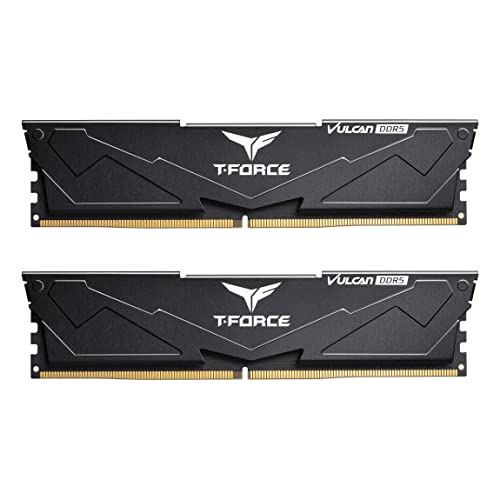
TEAMGROUP T-Force Vulcan 32GB DDR5-6000 CL38
Best for: Stable 6000MHz desktop performance
- Capacity
- 32GB
- Memory Speed
- 6000MHz
- CAS Latency
- CL38
- Kit Configuration
- 2x16GB
- Overclocking Profile
- XMP 3.0
- Compatible Device
- Desktop
View on Amazon: TEAMGROUP T-Force Vulcan 32GB DDR5-6000 CL38 Affiliate link
This 32GB kit offers 6000MHz speed with CL38 latency. It uses XMP 3.0 for easy setup. The black heatsink aids cooling. It suits desktop users needing reliable performance. The reinforced structure helps manage heat. You get stable power via PMICs. This model balances speed and efficiency for modern systems.
Pros
- 6000MHz memory speed
- CL38 CAS latency
- XMP 3.0 support
- Reinforced cooling structure
Cons
- Higher latency than faster variants
- Limited to 32GB capacity
- No RGB lighting mentioned
Good fit if
- You want 6000MHz DDR5 speed
- You prefer a low-profile black heatsink
- You need XMP 3.0 compatibility
Skip if
- You need speeds above 6000MHz
- You require RGB lighting effects
- You want 64GB or more capacity
Verdict: TEAMGROUP T-Force Vulcan DDR5 6000MHz fits users who prioritize stable 6000MHz performance with efficient cooling. It is ideal for desktop builds where speed and thermal management matter.
Specifications side by side
| Spec | TEAMGROUP Elite 32GB (2x16GB) DDR5 4800MHz UDIMM Kit | TEAMGROUP T-Force Vulcan 32GB DDR5-6000 CL38 |
|---|---|---|
| Capacity | 32GB | 32GB |
| Memory Speed | 4800MHz | 6000MHz |
| CAS Latency | CL40 | CL38 |
| Kit Configuration | 2x16GB | 2x16GB |
| Form Factor | 288 Pin UDIMM | not stated |
| Overclocking Profile | not stated | XMP 3.0 |
| Voltage | 1.1V | not stated |
| ECC Support | Non-ECC, On-die ECC | not stated |
| Compatible Device | Desktop, PC | Desktop |
| Size | 32GB | 32GB (2x16GB) |
| Dimensions | 5.91 × 50 × 30.3 inches | 5.51 × 0.3 × 1.29 inches |
| Weight | 0.53 ounces | 3.53 ounces |
| Color | Dual Channel | Black |
| Model | TED532G4800C40DC01 | FLBD532G6000HC38ADC01 |
Frequently asked questions
Is the TEAMGROUP Elite DDR5 kit good for standard desktop use?
Yes, it is a practical choice for standard desktop builds. The kit provides stable 32GB capacity at 4800MHz. This speed is sufficient for general computing tasks. It prioritizes efficiency and reliability over raw performance. You get a non-ECC UDIMM configuration that fits most standard motherboards.
Does the T-Force Vulcan offer better thermal management than the Elite?
The T-Force Vulcan is designed for efficient cooling. It targets users who need stable performance at 6000MHz. The kit includes a heatspreader to help dissipate heat. This makes it suitable for builds where thermal management is a priority compared to the simpler Elite design.
What is the difference in CAS latency between these two kits?
The T-Force Vulcan has a tighter CAS latency of CL38. The TEAMGROUP Elite operates at CL40. Lower latency means the memory responds faster to commands. This difference can improve responsiveness in latency-sensitive applications, making the Vulcan faster in specific scenarios.
Can I use the TEAMGROUP Elite for gaming?
You can use it for gaming, but it is not optimized for high-end performance. The 4800MHz speed is adequate for many titles. However, games that benefit from higher bandwidth may run slower compared to faster kits. It is best for users who value stability over maximum frame rates.
Is the T-Force Vulcan compatible with all DDR5 motherboards?
It is compatible with DDR5 desktop motherboards. The kit runs at 6000MHz, which may require XMP profile support. You must ensure your motherboard supports this speed. The T-Force Vulcan is designed for desktop PCs and fits standard UDIMM slots.
Which kit is better for future-proofing a desktop build?
The T-Force Vulcan is better for future-proofing. It offers 6000MHz speed and CL38 latency. These specs provide higher bandwidth and lower latency than the Elite. This combination supports more demanding applications and games. The Elite is suitable only if you do not need high-speed performance.
Does the TEAMGROUP Elite include a heatspreader?
The provided data does not mention a heatspreader for the Elite kit. It is described as a practical entry-level choice. The T-Force Vulcan, however, is noted for efficient cooling. You should check the physical product images if thermal design is critical for your build.
Are both kits dual channel configurations?
Yes, both kits are dual channel configurations. They each contain two 16GB modules for a total of 32GB. This setup ensures balanced data transfer between memory channels. You get improved performance compared to single-channel setups for both standard and high-speed tasks.