TEAMGROUP Elite 8GB DDR4 2666MHz vs TEAMGROUP T-Force Zeus 16GB DDR4 (2026): Key Differences
As an Amazon Associate we earn from qualifying purchases. Links on this page are affiliate links.
You are comparing the teamgroup elite ddr4 8gb single vs t force zeus ddr4 sodimm. Both modules run at 2666MHz with CL19 latency and use 1.2V voltage. The main difference lies in their physical design and target devices. The Elite is a UDIMM for desktops, while the Zeus is a SODIMM for laptops. You must choose the form factor that matches your computer's slot type to ensure compatibility.
Key differences
| Aspect | TEAMGROUP Elite 8GB DDR4 2666MHz UDIMM RAM | TEAMGROUP T-Force Zeus 16GB DDR4 SODIMM |
|---|---|---|
| Form Factor | UDIMM (288 Pin) | SODIMM (260 Pin) |
| Compatible Device | Desktop PC | Laptop |
| Capacity | 8GB (1x8GB) | 16GB (2x8GB) |
| Voltage | 1.2V | 1.2V |
| Memory Speed | 2666MHz | 2666MHz |
Which one should you choose?
Choose TEAMGROUP Elite 8GB DDR4 2666MHz UDIMM RAM if
- You are upgrading a desktop computer that requires standard UDIMM slots.
- You need a single 8GB stick for basic multitasking or gaming.
- You prefer a module with verified QVL compatibility for mainstream motherboards.
Choose TEAMGROUP T-Force Zeus 16GB DDR4 SODIMM if
- You are upgrading a laptop that requires compact SODIMM slots.
- You need double the memory capacity (16GB) for heavy multitasking or creative work.
- You require a dual-channel kit configuration (2x8GB) for improved performance.
Verdict: Choose the Elite if you are building or upgrading a desktop PC. Choose the Zeus if you need more memory for a laptop. Each serves a distinct form factor and capacity need.
Elite vs Zeus Key Specs
Compatible Device
The TEAMGROUP Elite 8GB DDR4 2666MHz UDIMM RAM is designed specifically for desktop computers. Its features list confirms compatibility with standard PC builds. In contrast, the TEAMGROUP T-Force Zeus 16GB DDR4 SODIMM is built for laptops. The SODIMM form factor allows it to fit into the smaller slots found in portable devices. You must choose the correct type for your hardware. Installing a UDIMM in a laptop will not work, and a SODIMM will not fit in a desktop motherboard slot. This distinction is critical for ensuring your memory works with your existing system.
Form Factor
Physical size determines where you can install the memory. The Elite uses a 288-pin UDIMM design, measuring 5.91 inches in length and 3.94 inches in width. This standard size is common in desktop towers. The T-Force Zeus uses a 260-pin SODIMM design, measuring 6.97 inches in length but only 0.51 inches in height. The SODIMM is significantly thinner to accommodate the tight spaces inside laptops. You cannot swap these modules between devices due to the different pin counts and physical dimensions. Your device dictates which form factor you need.
Capacity
Total memory capacity affects how many applications you can run simultaneously. The Elite comes as an 8GB single stick kit. This is suitable for basic tasks like web browsing and office work. The T-Force Zeus provides 16GB total capacity, configured as two 8GB sticks. This double the amount of memory allows for better multitasking and handling more demanding software. If you need more headroom for heavy workloads, the Zeus offers more space. However, the Elite is sufficient for lighter computing needs where 8GB is adequate.
Memory Speed
Both modules operate at the same base frequency. The Elite runs at 2666MHz, which is labeled as PC4-21300. The T-Force Zeus also runs at 2666MHz with the same PC4-21300 rating. This means data transfer rates are identical between the two products at their standard settings. Neither module has a higher advertised speed in the provided specifications. For general usage, both will perform similarly in terms of bandwidth. You do not gain any speed advantage by choosing one over the other based on frequency alone.
CAS Latency
Latency impacts how quickly the memory responds to requests. Both the Elite and the T-Force Zeus share a CAS Latency of CL19. This timing value is identical for both products, meaning they have the same delay in accessing data. The Elite is an unbuffered non-ECC module, while the Zeus specifications do not explicitly state ECC support, but both are standard consumer modules. Since the latency numbers match, there is no performance difference in timing. You will experience the same responsiveness from either stick during normal operations.
Which RAM kit fits your build
Desktop PC builder needing standard memory
You need a UDIMM for your desktop tower. This 8GB single stick runs at 2666MHz with CL19 latency. It uses 1.2V voltage and is Non-ECC. The 288-pin form factor fits standard desktop motherboards. It is QVL approved by main manufacturers for reliable compatibility in your system.
Laptop owner seeking upgraded capacity
Your laptop requires SODIMM memory. This 16GB kit provides double the capacity of standard 8GB sticks. It consists of two 8GB modules running at 2666MHz with CL19 latency. The 260-pin design fits laptop slots. It delivers the extra memory space you need for multitasking without fitting in a desktop.
User needing more than 8GB for work
If your workflow demands more than 8GB of RAM, this kit is the right choice. It offers 16GB total capacity in a 2x8GB configuration. This allows for smoother performance in demanding applications. The SODIMM form factor ensures it works in compatible laptops, providing the headroom you require for heavy tasks.
The products compared
TEAMGROUP Elite 8GB DDR4 2666MHz UDIMM RAM
Best for: basic desktop upgrades
- Total Capacity
- 8GB
- Memory Speed
- 2666MHz
- CAS Latency
- CL19
- Voltage
- 1.2V
- Module Configuration
- 1x8GB
- Form Factor
- UDIMM
View on Amazon: TEAMGROUP Elite 8GB DDR4 2666MHz UDIMM RAM Affiliate link
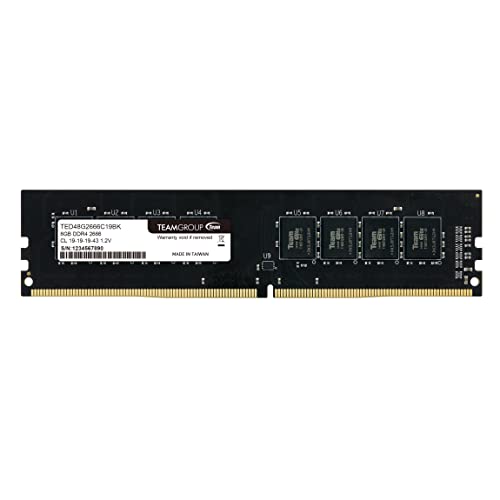
This is a single 8GB DDR4 module running at 2666MHz. It uses a standard 1.2V voltage and features CL19 latency. The stick is a Non-ECC UDIMM designed for desktop PCs. It fits in standard 288-pin slots. You should choose this if you need a basic upgrade for an older system or a budget build. It is not a dual-channel kit.
Pros
- 8GB single stick capacity
- 2666MHz memory speed
- 1.2V low voltage operation
- CL19 CAS latency
Cons
- Single channel configuration limits bandwidth
- 8GB capacity is smaller than 16GB kits
- UDIMM form factor restricts use to desktops
Good fit if
- You need a single stick upgrade for a desktop PC
- You are building on a tight budget
- Your motherboard supports 2666MHz speeds
Skip if
- You require dual-channel performance for gaming
- You need more than 8GB of memory
- You are buying for a laptop or SFF build
Verdict: TEAMGROUP Elite 8GB DDR4 2666MHz is a straightforward desktop memory stick for basic upgrades. It fits users who only need one stick and have limited budget constraints.

TEAMGROUP T-Force Zeus 16GB DDR4 SODIMM
Best for: Laptops needing 16GB of DDR4 RAM
- Total Capacity
- 16GB
- Memory Speed
- 2666MHz
- CAS Latency
- CL19
- Module Configuration
- 2x8GB
- Form Factor
- SODIMM
- Height
- 0.51 inches
View on Amazon: TEAMGROUP T-Force Zeus 16GB DDR4 SODIMM Affiliate link
This TEAMGROUP T-Force Zeus kit gives you 16GB of DDR4 memory in a 2x8GB configuration. It runs at 2666MHz with CL19 latency. The 260-pin SODIMM form factor is designed for laptops. You get double the capacity of the single 8GB stick on the list. This makes it better for multitasking and heavier workloads in compatible portable computers.
Pros
- 16GB total capacity (2x8GB modules)
- 2666MHz memory speed
- CL19 CAS latency
- 260-pin SODIMM form factor for laptops
Cons
- Higher latency than faster kits
- Requires two slots in your laptop
- Limited to 2666MHz speed
Good fit if
- You need 16GB of RAM for a laptop
- You run multiple applications at once
- Your laptop supports 2666MHz DDR4
Skip if
- You only have one memory slot available
- You need more than 16GB of RAM
- Your laptop requires faster than 2666MHz memory
Verdict: TEAMGROUP T-Force Zeus 16GB DDR4 SODIMM fits users who need double the memory of the standard 8GB option for better multitasking in laptops. It provides a solid capacity upgrade for compatible systems.
Specifications side by side
| Spec | TEAMGROUP Elite 8GB DDR4 2666MHz UDIMM RAM | TEAMGROUP T-Force Zeus 16GB DDR4 SODIMM |
|---|---|---|
| Total Capacity | 8GB | 16GB |
| Memory Speed | 2666MHz | 2666MHz |
| CAS Latency | CL19 | CL19 |
| Voltage | 1.2V | not stated |
| Module Configuration | 1x8GB | 2x8GB |
| Form Factor | UDIMM | SODIMM |
| ECC Support | Non-ECC | not stated |
| Height | 1.97 inches | 0.51 inches |
| Compatible Device | Desktop, PC | Laptop |
| Dimensions | 5.91 × 3.94 × 1.97 inches | 6.97 × 2.95 × 0.51 inches |
| Weight | 1.06 ounces | not stated |
| Size | 8GB Kit (1x8GB) | not stated |
| Color | Single Channel | not stated |
| Model | TED48G2666C1901 | Zeus SO-DIMM |
Frequently asked questions
Can I install the T-Force Zeus SODIMM in my desktop PC?
No, you cannot use the T-Force Zeus in a standard desktop. It is a SODIMM module designed specifically for laptops. Your desktop motherboard requires a UDIMM form factor. The Elite 8GB stick uses the correct UDIMM shape to fit desktop slots. Mixing these form factors will not work physically.
Do both RAM kits operate at the same speed?
Yes, both modules run at 2666MHz. The TEAMGROUP Elite and the T-Force Zeus share this memory speed rating. They also both feature CL19 latency and 1.2V voltage. The performance difference comes from capacity and form factor, not clock speed. You get the same frequency in either option.
Which option provides more memory capacity?
The T-Force Zeus offers more capacity with 16GB of RAM. The Elite kit provides only 8GB in a single stick. If you need to run more applications simultaneously, the 16GB Zeus is the better choice. The 8GB Elite is suitable for basic tasks only.
Is the Elite RAM compatible with ECC systems?
No, the TEAMGROUP Elite is Non-ECC memory. It does not support Error Correcting Code. This is standard for most consumer desktops. You do not need ECC unless your system specifically requires it for data integrity. The Zeus also lacks ECC support.
What are the physical dimensions of the Elite stick?
The Elite UDIMM measures 5.91 inches in length. It is 3.94 inches wide and 1.97 inches tall. The weight is 1.06 ounces. These dimensions fit standard desktop memory slots. The SODIMM is shorter and thinner to fit laptop spaces.
Can I use the Elite RAM in a laptop?
No, the Elite UDIMM will not fit in a laptop. UDIMMs are too large for laptop memory slots. Laptops require the smaller SODIMM form factor. The T-Force Zeus is the correct choice for portable computers. The Elite is strictly for desktop towers.
Does the Zeus kit include a heat spreader?
The data does not mention a heat spreader for the Zeus. It lists the model as Zeus SO-DIMM with specific dimensions. You should assume it is a standard module. The Elite also lacks mentioned cooling features. Both are basic memory sticks.