TEAMGROUP T-Force Delta RGB 16GB vs TEAMGROUP T-Force Delta RGB DDR4: Spec Comparison
As an Amazon Associate we earn from qualifying purchases. Links on this page are affiliate links.
You are comparing the teamgroup t force delta RGB ddr4 vs team t force delta RGB. Both kits share the same physical design, featuring an aluminum alloy heat sink and full-frame 120-degree RGB lighting. They also operate at the same 3200MHz speed and use the 288-pin DIMM form factor. The main difference lies in the total capacity and specific technical specifications like CAS latency and supported overclocking profiles. This comparison breaks down those spec differences to help you choose.
Key differences
| Aspect | TEAMGROUP T-Force Delta RGB 16GB DDR4-3200 | TEAMGROUP T-Force Delta RGB DDR4 8GB |
|---|---|---|
| Capacity | 16GB (2x8GB) | 8GB (2x4GB) |
| CAS Latency | CL16 | not listed |
| Overclocking Profile | XMP 2.0 | not listed |
| Voltage | not listed | 1.2V 1.4V |
Which one should you choose?
Choose TEAMGROUP T-Force Delta RGB 16GB DDR4-3200 if
- You need 16GB of total RAM for demanding tasks.
- You want to use XMP 2.0 for one-click overclocking.
- You prefer a known CL16 timing specification.
Choose TEAMGROUP T-Force Delta RGB DDR4 8GB if
- You are building a system that only requires 8GB of RAM.
- You want to see explicit voltage ratings of 1.2V or 1.4V.
- You are looking for the standard 288-pin DIMM form factor.
Verdict: Choose the 16GB kit if you need more memory capacity and verified XMP 2.0 support for easier overclocking. The 8GB kit is suitable only if your system has a lower memory requirement and you prefer the explicitly listed voltage options. Both kits offer identical physical aesthetics and base speeds.
Specs: T-Force Delta RGB DDR4
Kit configuration
Product A offers a 16GB configuration, split into two 8GB sticks. This provides a total capacity of 16GB for your desktop system. Product B is listed with a size of 8GB. The data for Product B does not explicitly confirm if this is a single stick or a 2x4GB kit, though the title mentions 2x8GB. If Product B is indeed 2x8GB, it matches Product A. If it is a single 8GB module, Product A provides double the memory capacity. You should verify the exact configuration for Product B before purchasing to ensure it meets your system requirements for multitasking and gaming performance.
CAS latency
Product A specifies a CAS Latency of CL16. This timing value indicates the delay between the memory controller requesting data and the data being available on the pins. Lower latency generally means faster response times. The data for Product B does not list a specific CAS Latency value. Without this specification, it is unclear if Product B shares the same CL16 timing or has a different, potentially higher, latency. If Product B also operates at CL16, the timing performance is identical. You need to check the full specifications for Product B to confirm if the latency matches Product A for optimal performance consistency.
Overclocking profile
Product A explicitly supports XMP 2.0 one-click overclocking technology. This allows you to easily enable higher speeds and tighter timings through your motherboard BIOS without manual tuning. It is also QVL approved by major motherboard manufacturers, ensuring compatibility. The data for Product B does not mention XMP support or any specific overclocking profile. While it may support XMP, this is not confirmed in the provided specifications. If Product B lacks XMP support, you would need to manually tune the memory, which is more complex. Product A offers a clearer path to optimized performance via XMP 2.0.
Operating voltage
Product B lists operating voltages of 1.2V and 1.4V. The 1.2V is the standard DDR4 voltage, while 1.4V is often required for higher speeds or overclocking. This indicates flexibility in power settings. The data for Product A does not specify the operating voltage. Standard DDR4 typically runs at 1.2V, but XMP profiles often require higher voltages. Without explicit data for Product A, you cannot confirm if it matches the voltage specifications of Product B. If both kits use standard voltages, power consumption will be similar. You should verify the voltage requirements for Product A to ensure compatibility with your power delivery system.
Software compatibility
Product A supports T-Force BLITZ control software (beta version) and Asus Aura Sync. This allows for RGB lighting customization and synchronization with compatible motherboards. Product B supports ASUS Aura Sync software synchronization. Both kits offer compatibility with Asus Aura Sync, ensuring you can control the RGB lighting if you have an Asus motherboard. Product A adds support for T-Force BLITZ, providing an additional software option for lighting control. If you use a non-Asus motherboard, you may need to check if T-Force BLITZ is compatible with your system. Both kits provide solid software support for RGB management.
Which T-Force Delta RGB kit fits you
Users needing maximum capacity for multitasking
Product A provides a full 16GB configuration, split into two 8GB sticks. This higher total capacity allows you to run more applications simultaneously without performance bottlenecks. It also includes a CAS Latency of CL16 and supports XMP 2.0 for one-click overclocking, ensuring stable high-speed performance for demanding desktop workloads.
Budget-conscious builders or upgrade users
Product B offers the same 3200MHz speed and identical physical design with an aluminum alloy heat spreader and full-frame RGB lighting. It operates at ultra-low voltages of 1.2V or 1.4V, which helps save energy. If you only need 8GB of memory, this kit delivers the essential aesthetics and speed at a lower capacity.
Those prioritizing software synchronization features
Product A explicitly supports T-Force BLITZ control software alongside Asus Aura Sync for lighting synchronization. While Product B also supports Asus Aura Sync, Product A lists additional software compatibility. This gives you more options to control the RGB effects and force flow lighting effect to match your system's theme.
The products compared
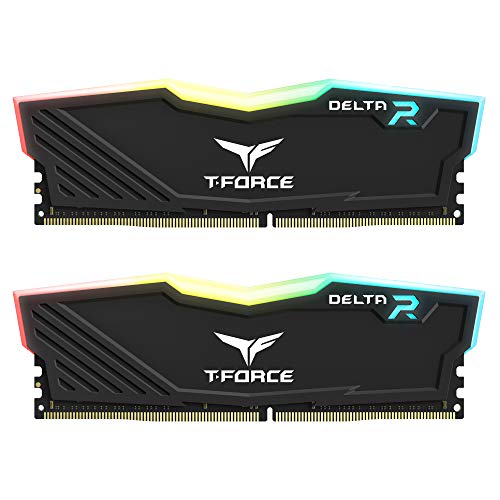
TEAMGROUP T-Force Delta RGB 16GB DDR4-3200
Best for: Desktop gaming with synchronized RGB lighting
- Total Capacity
- 16GB
- Memory Speed
- 3200MHz
- CAS Latency
- CL16
- Module Configuration
- 2x8GB
- Compatible Device
- Desktop
- Dimensions
- 5.79 × 0.28 × 1.93 inches
View on Amazon: TEAMGROUP T-Force Delta RGB 16GB DDR4-3200 Affiliate link
This is a 16GB DDR4 kit running at 3200MHz with CL16 latency. It uses an aluminum alloy heat sink with an asymmetrical minimalist design. The module features full-frame 120-degree ultra wide-angle RGB illumination. You get XMP 2.0 support for one-click overclocking. It works with T-Force BLITZ or Asus Aura Sync software. This kit suits desktop users who want synchronized lighting and reliable performance.
Pros
- 16GB capacity in a 2x8GB kit configuration
- 3200MHz memory speed with CL16 CAS latency
- XMP 2.0 one-click overclocking support
- Full-frame 120-degree wide-angle RGB lighting
- Aluminum alloy heat sink for thermal management
Cons
- Beta version software for T-Force BLITZ control
- No mention of physical remote control included
- Black color option only for this specific SKU
Good fit if
- You need 16GB of DDR4 RAM for gaming
- You want synchronized RGB lighting via Asus Aura Sync
- You prefer an asymmetrical minimalist heat sink design
Skip if
- You require DDR5 memory technology
- You need more than 16GB of capacity
- You prefer white colored memory modules
Verdict: TEAMGROUP T-Force Delta RGB 16GB DDR4 delivers solid 3200MHz performance with wide-angle RGB lighting. It fits desktop builders who value XMP 2.0 ease and aesthetic synchronization.

TEAMGROUP T-Force Delta RGB DDR4 8GB
Best for: ASUS users wanting 16GB DDR4 RGB
- Total Capacity
- 16GB
- Memory Speed
- 3200MHz
- CAS Latency
- CL16
- Voltage
- 1.2V
- Module Configuration
- 2x8GB
- Height
- 1.93 inches
View on Amazon: TEAMGROUP T-Force Delta RGB DDR4 8GB Affiliate link
This is a 16GB DDR4 kit (2x8GB) running at 3200MHz. It features an aluminum alloy heat spreader with an asymmetric minimalist design. The module includes full frame 120-degree RGB lighting and supports ASUS Aura Sync. It operates at 1.2V or 1.4V. You get 288-pin DIMMs for standard desktop builds. This kit suits users who want synchronized lighting and reliable JEDEC RC 2.0 PCB performance.
Pros
- 16GB capacity via 2x8GB modules
- 3200MHz memory speed
- Full frame 120-degree RGB lighting
- ASUS Aura Sync support
- Aluminum alloy heat spreader
Cons
- Only 16GB total capacity
- No mention of Intel XMP profiles
- Black color only
Good fit if
- You need 16GB of DDR4 RAM
- You want synchronized RGB lighting
- You use ASUS motherboards
Skip if
- You require 32GB or more
- You need DDR5 memory
- You prefer non-RGB modules
Verdict: TEAMGROUP T-Force Delta RGB 16GB DDR4 is a solid choice for gamers who want synchronized lighting and standard DDR4 speeds. It fits users with ASUS motherboards who need 16GB of memory.
Specifications side by side
| Spec | TEAMGROUP T-Force Delta RGB 16GB DDR4-3200 | TEAMGROUP T-Force Delta RGB DDR4 8GB |
|---|---|---|
| Total Capacity | 16GB | 16GB |
| Memory Speed | 3200MHz | 3200MHz |
| CAS Latency | CL16 | CL16 |
| Voltage | not stated | 1.2V |
| Module Configuration | 2x8GB | 2x8GB |
| Height | not stated | 1.93 inches |
| Compatible Device | Desktop | not stated |
| Size | 16GB (2x8GB) | 8GB |
| Dimensions | 5.79 × 0.28 × 1.93 inches | 5.79 × 0.28 × 1.93 inches |
| Weight | 3.53 ounces | 3.53 ounces |
| Color | Black | Black |
| Model | TF3D416G3200HC16CDC01 | TF3D416G3200HC16FDC01 |
Frequently asked questions
What is the main difference between the two T-Force Delta RGB kits?
The primary difference is total memory capacity. One kit provides 16GB using two 8GB sticks. The other is listed as an 8GB module. Both share identical physical dimensions, clock speeds, and RGB lighting features. You choose based on how much RAM your system requires for multitasking or gaming workloads.
Do both kits support XMP 2.0 profiles?
Yes, the 16GB kit explicitly supports XMP 2.0 for easy overclocking. This allows you to achieve the rated 3200MHz speed without manual configuration. While the 8GB kit shares the same speed rating, its specific XMP support details are not provided in the data. You should verify motherboard compatibility for both.
Are the physical dimensions identical for both memory kits?
Yes, both kits share the exact same physical footprint. They measure 5.79 inches in length, 1.93 inches in height, and 0.28 inches in width. The weight is also identical at 3.53 ounces. This ensures they will fit in the same cases and coolers without clearance issues.
Which kit is better for ASUS motherboard users?
The 8GB kit is highlighted as a solid choice for ASUS users needing 16GB total memory. However, the data lists its size as 8GB, which may imply a single stick or a different configuration. The 16GB kit is also noted for aesthetic synchronization, which works well with ASUS Aura Sync ecosystems.
What is the CAS latency for these DDR4 modules?
The 16GB kit features a CAS latency of CL16. This timing works with its 3200MHz speed to provide responsive performance for desktop gaming. The specific CAS latency for the 8GB kit is not listed in the provided data. You should assume similar timings if they share the same architecture.
Can I use these kits for desktop gaming?
Both kits are designed for desktop use. The 16GB kit is specifically recommended for desktop gaming with synchronized RGB lighting. It delivers solid performance at 3200MHz. The 8GB kit is also suitable for gaming, particularly if you need standard DDR4 speeds with aesthetic customization for your build.
Do these kits come in colors other than black?
The provided data specifies that both kits are available in black. No other color options are listed for either the 16GB or 8GB configurations. If you require a different aesthetic, you may need to check other product lines from TEAMGROUP that are not included in this comparison.