TEAMGROUP vs Kingston: DDR4 RAMS Compared by Specs
As an Amazon Associate we earn from qualifying purchases. Links on this page are affiliate links.
This TEAMGROUP vs kingston ddr4 RAM comparison looks at two very different modules. Both use DDR4 technology and operate at 1.2V, which helps reduce power consumption. The main difference lies in their intended use and capacity. One is a single stick for desktops, while the other is a full server kit. You need to match the specs to your specific hardware requirements.
Key differences
| Aspect | TEAMGROUP Elite 8GB DDR4 2666MHz UDIMM RAM | Kingston 64GB DDR4 ECC REG Server Kit |
|---|---|---|
| Compatible Device | Desktop, PC | Server |
| Form Factor | UDIMM | Registered DIMM |
| ECC Support | Non-ECC | ECC |
| Memory Speed | 2666MHz | 2133MHz |
| Total Capacity | 8GB (1x8GB) | 64GB (4x16GB) |
Which one should you choose?
Choose TEAMGROUP Elite 8GB DDR4 2666MHz UDIMM RAM if
- You are upgrading a standard desktop or PC.
- You need a single 8GB stick for basic tasks.
- You prefer higher memory speed at 2666MHz.
Choose Kingston 64GB DDR4 ECC REG Server Kit if
- You are building or maintaining a server.
- You require ECC memory for data integrity.
- You need a high-capacity 64GB kit for heavy workloads.
Verdict: The TEAMGROUP module is the practical choice for standard desktop computers needing a simple capacity boost. The Kingston kit is strictly for server environments that demand ECC support and large memory pools. Choose based on your device type and capacity needs.
TEAMGROUP vs Kingston RAM Specs
compatible device
You need to match the RAM to your hardware. The TEAMGROUP Elite is designed for desktops and PCs. It uses standard UDIMM technology. This makes it suitable for typical home or office computers. Kingston offers a different path. Its kit is built for servers. The product title and attributes confirm this focus. Servers handle heavy data loads and require specialized memory. If you are building a standard PC, the TEAMGROUP option fits your motherboard slots. If you are setting up a server rack, the Kingston module is the correct choice. Using the wrong type can prevent your system from booting or running stably.
memory speed
Speed affects how quickly data moves between the memory and the processor. The TEAMGROUP Elite runs at 2666MHz. This is a common speed for modern desktop systems. It balances performance and cost well. Kingston operates at 2133MHz. This is slower than the TEAMGROUP module. However, server memory prioritizes stability and error correction over raw speed. The lower frequency is standard for many server workloads. For a desktop user, the higher 2666MHz clock on the TEAMGROUP kit provides faster data access. For a server, the Kingston speed is adequate for its intended tasks. You should choose based on your system requirements.
ecc support
Error Correction Code (ECC) memory detects and fixes data errors. This is critical for servers where data integrity is paramount. The Kingston kit includes ECC support. It ensures that corrupted data does not cause system crashes or silent failures. The TEAMGROUP Elite is Non-ECC. It does not have this error-checking feature. This is standard for consumer desktops where the cost of ECC is not justified. If you run databases or virtual machines, the Kingston ECC is vital. For gaming or general office work, the TEAMGROUP Non-ECC is sufficient. You lose the safety net of ECC with the TEAMGROUP module.
form factor
The physical shape and pin count determine if the RAM fits your motherboard. TEAMGROUP uses a 288-pin UDIMM. This is the standard Unbuffered DIMM for desktops. It fits into standard DIMM slots on consumer motherboards. Kingston uses a 240-pin Registered DIMM. The pin count is different, and the internal architecture includes a register. This prevents the Kingston module from fitting into a standard desktop slot. It is strictly for server motherboards with registered DIMM slots. You cannot mix these form factors. The TEAMGROUP UDIMM is for general PCs. The Kingston Registered DIMM is for enterprise hardware.
cas latency
CAS Latency (CL) measures the delay before data is available. Lower numbers mean faster response times. The Kingston kit has a CL15 rating. The TEAMGROUP Elite has a CL19 rating. At first glance, Kingston appears faster due to the lower number. However, you must consider the memory speed. Kingston runs at 2133MHz, while TEAMGROUP runs at 2666MHz. The higher clock speed of TEAMGROUP often offsets its higher latency in real-world desktop tasks. The Kingston CL15 is optimized for its 2133MHz speed. Both are within normal ranges for their respective categories. Neither offers a clear advantage without context.
capacity
Capacity determines how much data the system can hold in active memory. The TEAMGROUP Elite is an 8GB single stick. This is enough for basic tasks like web browsing and office work. It can be combined with other 8GB sticks for more memory. Kingston provides a massive 64GB kit. It comes as four 16GB sticks. This high capacity is designed for servers running multiple virtual machines or large databases. You cannot use the Kingston kit in a standard desktop with only four slots. The TEAMGROUP 8GB is for entry-level or mid-range builds. The Kingston 64GB is for high-end server environments.
Choose the Right RAM Kit
Desktop PC user needing basic upgrade
This TEAMGROUP module fits standard desktops. It offers 8GB capacity at 2666MHz speed. The CL19 latency is standard for this class. It uses 1.2V voltage for efficiency. The UDIMM form factor ensures compatibility with most consumer motherboards. This is a straightforward choice for everyday computing tasks.
Server administrator requiring high capacity
This Kingston kit provides 64GB of total memory. It uses four 16GB sticks for dense configuration. The ECC and Registered features protect data integrity in servers. The CL15 latency offers tight timing for server workloads. This kit is built for enterprise environments where stability and large memory pools are critical requirements.
Budget builder seeking single stick
You get a single 8GB stick with this TEAMGROUP option. It runs at 2666MHz, which is faster than the Kingston server kit. The non-ECC design is sufficient for non-critical desktop use. It is a cost-effective way to add memory to a standard PC without needing a server-grade platform.
The products compared
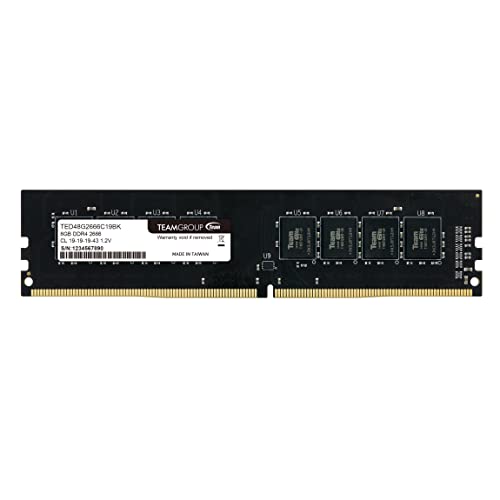
TEAMGROUP Elite 8GB DDR4 2666MHz UDIMM RAM
Best for: basic desktop memory upgrades
- Total Capacity
- 8GB
- Memory Speed
- 2666MHz
- CAS Latency
- CL19
- Voltage
- 1.2V
- Module Configuration
- 1x8GB
- Form Factor
- UDIMM
View on Amazon: TEAMGROUP Elite 8GB DDR4 2666MHz UDIMM RAM Affiliate link
This TEAMGROUP Elite module offers 8GB of DDR4 memory running at 2666MHz. It uses a 1.2V voltage and features CL19 latency. The stick is a single-channel UDIMM without ECC support. It fits standard desktop PCs. You should choose this if you need a basic, low-cost upgrade for older systems or light daily tasks. It does not suit high-end gaming or server workloads.
Pros
- 2666MHz memory speed for standard desktop performance
- 1.2V low voltage for efficient power use
- CL19 CAS latency for reliable timing
- UDIMM form factor fits most consumer motherboards
Cons
- Single 8GB stick limits multitasking compared to kits
- Non-ECC support unsuitable for data-critical servers
- Lower speed than the 2133MHz ECC option on this list
Good fit if
- You are upgrading a single-channel desktop PC
- You need affordable, basic system memory
- You want a JEDEC-compliant module for compatibility
Skip if
- You require ECC memory for server stability
- You need high-speed gaming performance over 2666MHz
- You want a dual-channel 16GB kit for better multitasking
Verdict: TEAMGROUP Elite 8GB DDR4 2666MHz is a solid choice for basic desktop upgrades. It fits users who need reliable, low-voltage memory for everyday computing tasks.
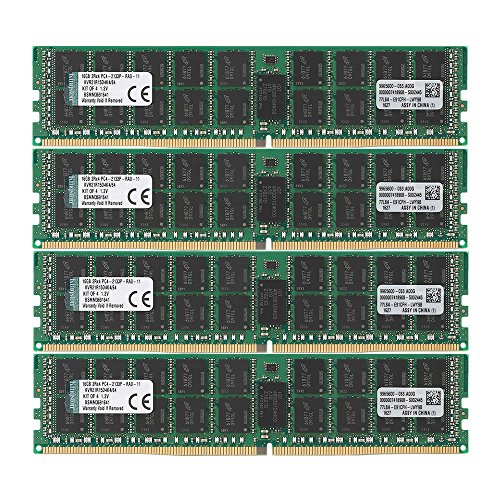
Kingston 64GB DDR4 ECC REG Server Kit
Best for: Server systems needing 64GB ECC memory
- Total Capacity
- 64GB
- Memory Speed
- 2133MHz
- CAS Latency
- CL15
- Module Configuration
- 4x16GB
- Form Factor
- DIMM
- ECC Support
- ECC Reg
View on Amazon: Kingston 64GB DDR4 ECC REG Server Kit Affiliate link
This Kingston kit delivers 64GB of DDR4 memory across four 16GB modules. It runs at 2133MHz with a tight CL15 latency. The modules feature ECC and registered DIMM technology, making them suitable for server environments. You get increased bandwidth and lower power consumption compared to older standards. This kit is designed for systems requiring high stability and error correction.
Pros
- 64GB total capacity from four 16GB modules
- 2133MHz speed with CL15 latency
- ECC and Registered DIMM support
- Decreases voltage for better power efficiency
Cons
- Lower 2133MHz speed compared to modern DDR4 standards
- Requires server-compatible motherboards
- Not suitable for standard desktop PCs
Good fit if
- You need ECC memory for server stability
- You are building a system requiring 64GB capacity
- You require registered DIMM technology
Skip if
- You are upgrading a standard desktop computer
- You need speeds higher than 2133MHz
- You do not require ECC error correction
Verdict: Kingston 64GB DDR4 ECC Reg Server RAM is a specialized kit for server builds. It fits users who need high capacity and error correction over raw speed.
Specifications side by side
| Spec | TEAMGROUP Elite 8GB DDR4 2666MHz UDIMM RAM | Kingston 64GB DDR4 ECC REG Server Kit |
|---|---|---|
| Total Capacity | 8GB | 64GB |
| Memory Speed | 2666MHz | 2133MHz |
| CAS Latency | CL19 | CL15 |
| Voltage | 1.2V | not stated |
| Module Configuration | 1x8GB | 4x16GB |
| Form Factor | UDIMM | DIMM |
| ECC Support | Non-ECC | ECC Reg |
| Height | 1.97 inches | not stated |
| Compatible Device | Desktop, PC | Server |
| Size | 8GB Kit (1x8GB) | 64GB |
| Dimensions | 5.91 × 3.94 × 1.97 inches | 13 × 4.5 × 0.1 inches |
| Weight | 1.06 ounces | 0.35 ounces |
| Color | Single Channel | Multicolor |
| Model | TED48G2666C1901 | KVR21R15D4K4/64 |
Frequently asked questions
Can I use the Kingston 64GB ECC REG kit in my standard desktop PC?
No, you cannot. This Kingston module is designed specifically for server systems. It uses ECC REG technology, which is not compatible with standard desktop motherboards. You need a server-compatible board to use this high-capacity memory kit.
Does the TEAMGROUP Elite RAM support error correction?
No, it does not. The TEAMGROUP Elite 8GB DDR4 is listed as Non-ECC. This means it lacks the error-checking features found in server memory. It is intended for general desktop use where basic reliability is sufficient.
What is the CAS latency for the Kingston server RAM?
The CAS latency is CL15. This specification indicates the delay before the RAM responds to a command. Lower latency can improve performance in server environments, though the 2133MHz speed is also a factor in overall system responsiveness.
Is the TEAMGROUP Elite kit dual channel ready?
The product data lists the color as Single Channel, indicating it is a single stick. To achieve dual-channel performance, you would need to purchase a second identical 8GB module. This setup allows for faster data transfer rates between the RAM and CPU.
How much does the Kingston server RAM weigh?
The Kingston 64GB DDR4 ECC REG kit weighs 0.35 ounces. This light weight is typical for server memory modules. The compact dimensions also help with airflow and space management inside server chassis or rack-mounted systems.
What voltage does the TEAMGROUP Elite RAM operate at?
It operates at 1.2V. This standard DDR4 voltage helps reduce power consumption and heat generation. It is efficient for everyday computing tasks and ensures compatibility with most modern desktop motherboards that support standard DDR4 specifications.
Can the Kingston kit fit in a standard DIMM slot?
No, it cannot. The Kingston module is an ECC REG type, which has a different physical notch position and pin configuration than standard UDIMM RAM. It requires a server motherboard with specific support for registered ECC memory to function correctly.