Timetec 32GB DDR4 3200MHz UDIMM or Timetec 32GB DDR4 3200MHz ECC? Which Timetec Model to Buy
As an Amazon Associate we earn from qualifying purchases. Links on this page are affiliate links.
You are comparing the timetec 32gb ddr4 3200mhz udimm vs 32gb ddr4 3200mhz ecc models. Both kits offer 32GB capacity and run at 3200MHz with CL22 latency and 1.2V voltage. The main difference lies in their form factor and error correction. One is a standard desktop UDIMM, while the other is a laptop-oriented SODIMM with ECC support. Understanding these distinctions helps you select the right memory for your specific system requirements.
Key differences
| Aspect | Timetec 32GB DDR4 3200MHz UDIMM Memory | Timetec 32GB DDR4 3200MHz ECC SODIMM |
|---|---|---|
| Form Factor | 288 Pin UDIMM | 260 Pin SODIMM |
| ECC Support | Non-ECC | Unbuffered ECC |
| Compatible Device | Desktop PC | Workstation Laptops |
| Overclocking Profile | Non-XMP | not listed |
Which one should you choose?
Choose Timetec 32GB DDR4 3200MHz UDIMM Memory if
- You need memory for a standard desktop computer.
- Your system requires Non-ECC unbuffered RAM.
- You want a 288-pin UDIMM module.
Choose Timetec 32GB DDR4 3200MHz ECC SODIMM if
- You are upgrading a compatible precision workstation laptop.
- Your system requires ECC memory for data integrity.
- You need a 260-pin SODIMM module.
Verdict: Choose the UDIMM if you are building or upgrading a desktop PC. Select the ECC SODIMM if you are working with compatible precision workstations that require error-correcting memory. The form factor and ECC support are the deciding factors for compatibility.
UDIMM vs ECC SODIMM Comparison
Form Factor
Product A uses a standard 288-pin UDIMM designed for desktop computers. This is the typical stick you slide into a full-size desktop motherboard. Product B uses a 260-pin SODIMM. This smaller form factor is built for laptops and compact workstations. You cannot swap these modules. A desktop board will not accept the SODIMM, and a laptop slot will not fit the UDIMM. Your choice depends entirely on whether your machine takes standard desktop sticks or smaller laptop-style modules. Check your device manual to see which slot type you have before buying.
Compatible Device
Product A is explicitly for selected DDR4 desktops. The listing states it is not for laptops, mini PCs, or all-in-one devices. Product B lists compatibility with Dell Precision mobile workstations like the 3551, 5550, and 7760 models. These are high-end portable workstations. If you have a standard desktop tower, Product A is your only option. If you are upgrading a Precision mobile workstation, Product B is the correct choice. They serve two completely different hardware ecosystems. Do not assume they are interchangeable based on brand alone.
ECC Support
Product A is Non-ECC Unbuffered memory. It lacks error correction features. This is standard for most consumer desktops. Product B is Unbuffered ECC memory. It includes error-correcting code capabilities to detect and fix memory data corruption. This is vital for professional workstations where data integrity is critical. If your desktop motherboard does not support ECC, Product B will not work or may cause instability. If your Precision workstation requires ECC, Product A will fail. Match the ECC requirement of your motherboard exactly.
Overclocking Profile
Product A is listed as Non-XMP. This means it does not include an Intel XMP profile for automatic overclocking. You must manually configure timings in your BIOS to run it at higher speeds. Product B does not list an XMP profile in its data. Both kits rely on standard JEDEC specifications for their 3200MHz speed. Neither offers plug-and-play overclocking profiles out of the box. You will need to enter your BIOS settings to enable the advertised speed on either module. Neither has an advantage in automated tuning features.
Memory Speed
Both kits operate at a base speed of 3200MHz. Product A can downclock to 2933MHz or 2666MHz if your system only supports those lower speeds. Product B is rated for 3200MHz PC4-25600. Both share the same CAS Latency of CL22. They also both run at 1.2V voltage. The electrical performance metrics are identical. The speed rating does not favor one over the other. You get the same bandwidth and latency characteristics from both modules. The difference is purely in physical shape and error correction capabilities.
Choose the Right Timetec Memory
Desktop PC users needing standard RAM
You need a 288-pin UDIMM stick for your desktop motherboard. This module runs at 3200MHz with CL22 latency and 1.2V voltage. It supports downclocking to 2933MHz or 2666MHz if your system requires lower speeds. It is Non-ECC, which fits most standard consumer desktops perfectly.
Precision workstation owners requiring ECC
You are using a Dell Precision workstation like the 3551 or 5560. You need 260-pin SODIMM memory with Unbuffered ECC support. This module ensures data integrity for professional workloads. It runs at 3200MHz with CL22 latency and 1.2V voltage, matching your system's specific requirements.
General desktop builders on a budget
You are building or upgrading a standard desktop computer. This 32GB UDIMM provides reliable performance at 3200MHz. It lacks ECC, which is unnecessary for most gaming and office tasks. The Non-XMP design ensures compatibility with standard BIOS settings without requiring manual profile configuration.
The products compared

Timetec 32GB DDR4 3200MHz UDIMM Memory
Best for: Desktops needing large single-stick capacity
- Total Capacity
- 32GB
- Memory Speed
- 3200MHz
- CAS Latency
- CL22
- Voltage
- 1.2V
- Module Configuration
- 1x32GB
- Form Factor
- UDIMM
View on Amazon: Timetec 32GB DDR4 3200MHz UDIMM Memory Affiliate link
This is a single 32GB DDR4 stick running at 3200MHz. It uses a standard 1.2V voltage and CL22 latency. The module is unbuffered and lacks error-correcting code. It works in desktop PCs that support DDR4 speeds. The RAM can downclock to 2933MHz or 2666MHz if your system requires it. It is not designed for laptops or mini PCs.
Pros
- 32GB capacity in a single module
- 3200MHz speed with downclock support
- Standard 1.2V voltage for efficiency
- CL22-22-22-52 timing configuration
Cons
- Lacks ECC for error correction
- Non-XMP profile limits overclocking
- Single stick configuration
Good fit if
- You need high capacity for desktop workstations
- You use a standard DDR4 desktop motherboard
- You prefer standard non-ECC memory
Skip if
- You require ECC for server stability
- You are building a laptop or mini PC
- You need XMP overclocking profiles
Verdict: Timetec 32GB DDR4 3200MHz Non-ECC UDIMM fits desktop users who need large single-stick capacity without error correction. It is not suitable for systems requiring ECC or overclocking profiles.
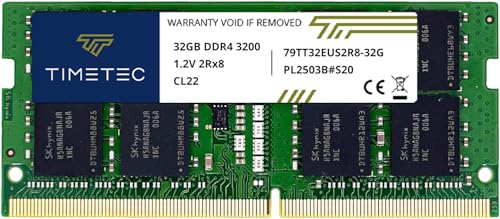
Timetec 32GB DDR4 3200MHz ECC SODIMM
Best for: Dell Precision workstations needing ECC memory
- Total Capacity
- 32GB
- Memory Speed
- 3200MHz
- CAS Latency
- CL22
- Voltage
- 1.2V
- Module Configuration
- 1x32GB
- Form Factor
- UDIMM
View on Amazon: Timetec 32GB DDR4 3200MHz ECC SODIMM Affiliate link
This is a 32GB DDR4 SODIMM running at 3200MHz with unbuffered ECC support. It uses 1.2V and CL22 latency in a 2Rx8 dual-rank configuration. The module fits compatible Dell Precision workstations. You should choose this if you need error-correcting memory for professional tasks. It is a single stick, so you will need a second one for dual-channel performance on most systems.
Pros
- 32GB capacity per stick
- 3200MHz memory speed
- Unbuffered ECC support
- 1.2V operating voltage
- CL22 CAS latency
Cons
- Single 1x32GB kit configuration
- SODIMM form factor limits desktop use
- No XMP profile support listed
Good fit if
- You use a compatible Dell Precision workstation
- You require ECC memory for data integrity
- You need high-capacity laptop or small-form-factor memory
Skip if
- You are building a standard desktop PC
- You need a dual-stick kit for immediate dual-channel
- You require non-ECC unbuffered memory for consumer motherboards
Verdict: Timetec 32GB DDR4 3200MHz ECC SODIMM provides reliable error-correcting memory for compatible Dell Precision workstations. It suits professionals who prioritize data stability over gaming performance in mobile or workstation environments.
Specifications side by side
| Spec | Timetec 32GB DDR4 3200MHz UDIMM Memory | Timetec 32GB DDR4 3200MHz ECC SODIMM |
|---|---|---|
| Total Capacity | 32GB | 32GB |
| Memory Speed | 3200MHz | 3200MHz |
| CAS Latency | CL22 | CL22 |
| Voltage | 1.2V | 1.2V |
| Module Configuration | 1x32GB | 1x32GB |
| Form Factor | UDIMM | UDIMM |
| ECC Support | Non-ECC | ECC |
| Compatible Device | Desktop, PC | not stated |
| Size | 32GB | 3200MHz 32GB |
| Color | Black | not stated |
Frequently asked questions
Can I use the Timetec 32GB DDR4 3200MHz UDIMM in a laptop?
No. The UDIMM version uses a 288-pin form factor designed strictly for desktop computers. It will not fit into the 260-pin SODIMM slots found in laptops or workstations. You must select the SODIMM model if your device is a portable computer or a compact workstation.
Is the Timetec 32GB DDR4 3200MHz ECC memory non-ECC?
No. The ECC SODIMM model explicitly supports error-correcting code technology. This feature detects and fixes data corruption, which is vital for professional workstations. The UDIMM model, by contrast, is listed as Non-ECC and lacks this specific data integrity feature.
Do both Timetec models run at the same voltage?
Yes. Both the UDIMM and the ECC SODIMM variants operate at 1.2V. This standard voltage ensures compatibility with modern DDR4 systems. You do not need to worry about power differences between the desktop and workstation versions regarding their electrical requirements.
Which Timetec RAM is better for a Dell Precision workstation?
The ECC SODIMM is the correct choice. Dell Precision workstations typically require error-correcting memory and use the smaller SODIMM form factor. The UDIMM desktop stick is incompatible with these systems due to its pin count and lack of ECC support.
What is the CAS latency for these Timetec kits?
Both models feature a CAS latency of CL22. This timing applies to the 3200MHz speed rating for both the desktop UDIMM and the workstation SODIMM. You can expect identical timing characteristics between the two form factors at this speed.
Can I mix the UDIMM and ECC SODIMM in the same system?
No. These modules have different physical sizes and pin counts. The UDIMM is a 288-pin stick for desktops, while the ECC version is a 260-pin SODIMM for laptops. They cannot physically fit into each other's slots, nor are they designed to work together.
Does the Timetec 32GB DDR4 3200MHz UDIMM support XMP?
The product data does not list XMP support. It is described as a straightforward high-capacity option for desktop users. If you require automatic overclocking profiles, this specific UDIMM model may not provide that feature based on the available specifications.