Timetec vs TEAMGROUP: DDR4 RAMS Compared by Specs
As an Amazon Associate we earn from qualifying purchases. Links on this page are affiliate links.
This timetec vs TEAMGROUP ddr4 RAM guide compares two distinct modules. Both use 1.2V and are Non-ECC UDIMMs for desktops. The main difference is capacity and speed. Timetec offers a 32GB stick at 3200MHz. TEAMGROUP provides an 8GB stick at 2666MHz. You need to decide if you want higher capacity or a smaller, standard module. The specs below show how they differ.
Key differences
| Aspect | Timetec 32GB DDR4 3200MHz UDIMM Memory | TEAMGROUP Elite 8GB DDR4 2666MHz UDIMM RAM |
|---|---|---|
| Memory Speed | 3200MHz | 2666MHz |
| Capacity | 32GB | 8GB |
| CAS Latency | CL22 | CL19 |
| Overclocking Profile | Non-XMP | not listed |
Which one should you choose?
Choose Timetec 32GB DDR4 3200MHz UDIMM Memory if
- You need high capacity for heavy multitasking.
- You want faster memory speeds up to 3200MHz.
- You are building a desktop with large memory needs.
Choose TEAMGROUP Elite 8GB DDR4 2666MHz UDIMM RAM if
- You need a lower cost entry point.
- You prefer tighter CAS latency for basic tasks.
- You want a standard JEDEC compliant module.
Verdict: Choose Timetec if you require maximum capacity and higher speeds for demanding desktop workloads. Choose TEAMGROUP if you need a smaller, standard capacity module with tighter latency for basic computing. Both are reliable Non-ECC options for desktop PCs.
Timetec vs TEAMGROUP DDR4 Specs
Memory Speed
Timetec offers a higher base speed of 3200MHz on this 32GB module. It can downclock to 2933MHz or 2666MHz if your system requires it. TEAMGROUP provides a 2666MHz speed on its 8GB stick. Both operate at standard JEDEC specifications without requiring XMP profiles for these base speeds. If you need faster data transfer rates for demanding tasks, the Timetec option runs at a higher frequency out of the box. The TEAMGROUP module sticks to the slower 2666MHz standard. Speed matters for bandwidth-heavy workloads.
Capacity
Capacity is the most obvious difference between these two kits. Timetec provides a single 32GB stick. This allows you to reach high total memory with fewer slots used. TEAMGROUP offers an 8GB single stick. You would need four of these to match the capacity of one Timetec module. For gaming or creative work, 32GB is often the sweet spot. 8GB is sufficient for basic office tasks but fills up quickly. You should choose based on your total system memory needs, not just the stick size.
CAS Latency
Latency affects how quickly the RAM responds to commands. TEAMGROUP lists a CAS Latency of CL19. Timetec lists a CAS Latency of CL22. Lower numbers are generally better for latency. However, Timetec runs at a higher frequency. Higher speed can sometimes offset higher latency in real-world performance. The TEAMGROUP stick has tighter timing at its slower speed. The Timetec stick has looser timing at a faster speed. Both are Non-ECC modules. This spec is a minor trade-off between speed and latency.
Overclocking Profile
Both modules are Non-XMP by default. Timetec explicitly states it is Non-XMP. TEAMGROUP notes it complies with JEDEC specifications. This means you should not expect one-click overclocking profiles from either stick out of the box. You will rely on standard BIOS settings for any adjustments. Neither product advertises specific XMP profiles in the provided data. If you want easy overclocking, you might look for XMP-enabled kits instead. For stable, plug-and-play operation, both fit the bill equally well.
Form Factor
Both products use the standard 288-pin UDIMM form factor. This ensures compatibility with standard desktop motherboards. Timetec is a 2Rx8 Dual Rank module. TEAMGROUP does not specify rank in the key specs. Both are Non-ECC, which is standard for consumer desktops. You do not need to worry about server-grade ECC support. The physical size fits standard desktop towers. Laptop users cannot use either module, as both are designed for desktop PCs. The form factor is identical for installation purposes.
Choose your DDR4 RAM kit
Users needing high capacity for multitasking
You should pick the Timetec module if you require 32GB of memory on a single stick. This configuration supports speeds up to 3200MHz and downclocks to 2933MHz or 2666MHz as needed. It is a Non-XMP, Non-ECC UDIMM designed for desktops. The 1.2V voltage ensures standard power efficiency for your system.
Budget buyers or small system upgrades
The TEAMGROUP Elite is the better choice if you only need 8GB of RAM. It operates at 2666MHz with a CAS latency of CL19. This stick is a Non-ECC UDIMM that complies with JEDEC specifications. It is ideal for basic desktop setups where lower capacity is sufficient for your daily tasks.
Users prioritizing motherboard compatibility
If motherboard compatibility is your main concern, the TEAMGROUP module is QVL approved by mainstream manufacturers. This approval helps ensure the 8GB 2666MHz stick works reliably with your specific board. The Timetec option lacks this specific QVL mention in the provided data, making TEAMGROUP the safer spec-based choice for compatibility.
The products compared

Timetec 32GB DDR4 3200MHz UDIMM Memory
Best for: Desktops needing 32GB single-stick capacity
- Total Capacity
- 32GB
- Memory Speed
- 3200MHz
- CAS Latency
- CL22
- Voltage
- 1.2V
- Module Configuration
- 1x32GB
- Form Factor
- UDIMM
View on Amazon: Timetec 32GB DDR4 3200MHz UDIMM Memory Affiliate link
This Timetec module delivers 32GB of DDR4 memory running at 3200MHz with a CL22 latency. It uses 1.2V power and features a Non-ECC, unbuffered design suitable for standard desktops. The kit supports downclocking to 2933MHz or 2666MHz if your system requires it. You get a single 32GB stick in a black finish. This option suits users needing high capacity for desktop workloads without the complexity of overclocking profiles.
Pros
- 32GB single-module capacity
- 3200MHz base speed
- Compatible with 2933MHz and 2666MHz systems
- 1.2V low voltage operation
- Lifetime warranty included
Cons
- Non-XMP design limits manual overclocking
- No heat spreader for thermal management
- Not compatible with laptops or mini PCs
Good fit if
- You need a single high-capacity stick for desktop upgrades
- You want standard speeds without overclocking complexity
- You require a lifetime warranty for peace of mind
Skip if
- You are building a compact mini PC or laptop
- You need XMP profiles for manual overclocking
- You prefer modules with heat spreaders
Verdict: Timetec 32GB DDR4 3200MHz Desktop RAM is a straightforward high-capacity solution for users who need 32GB in a single stick. It fits desktops requiring stable, non-overclocked performance at 3200MHz or lower speeds.
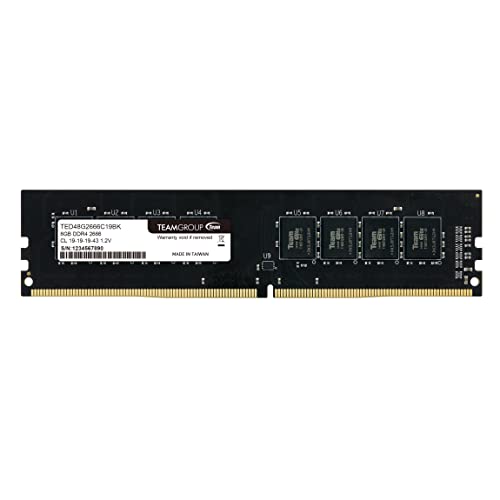
TEAMGROUP Elite 8GB DDR4 2666MHz UDIMM RAM
Best for: basic desktop upgrades needing 8GB
- Total Capacity
- 8GB
- Memory Speed
- 2666MHz
- CAS Latency
- CL19
- Voltage
- 1.2V
- Module Configuration
- 1x8GB
- Form Factor
- UDIMM
View on Amazon: TEAMGROUP Elite 8GB DDR4 2666MHz UDIMM RAM Affiliate link
This is an 8GB single-channel DDR4 stick running at 2666MHz. It uses a 1.2V voltage and has a CAS Latency of CL19. The module is a 288-pin UDIMM that is Non-ECC. It meets JEDEC specifications and holds QVL approval from motherboard makers. You need this if you are building a basic desktop or adding a single stick of memory to an existing system.
Pros
- 8GB capacity in a single stick configuration
- 2666MHz memory speed for standard desktop use
- 1.2V low working voltage for efficiency
- QVL approved by mainstream motherboard manufacturers
Cons
- Single-channel configuration limits bandwidth compared to dual-channel kits
- 8GB capacity is small for modern high-end workloads
- CL19 latency is slower than higher-performance DDR4 modules
Good fit if
- You need a single 8GB stick for a basic desktop
- You are upgrading a system that supports one additional DIMM slot
- You want a JEDEC-compliant module with QVL approval
Skip if
- You require dual-channel performance for gaming or editing
- You need more than 8GB of memory in one stick
- You want high-speed memory above 2666MHz
Verdict: TEAMGROUP Elite DDR4 8GB 2666MHz is a standard single-stick solution for basic desktop upgrades. You should buy it if you only need 8GB of single-channel memory for light tasks.
Specifications side by side
| Spec | Timetec 32GB DDR4 3200MHz UDIMM Memory | TEAMGROUP Elite 8GB DDR4 2666MHz UDIMM RAM |
|---|---|---|
| Total Capacity | 32GB | 8GB |
| Memory Speed | 3200MHz | 2666MHz |
| CAS Latency | CL22 | CL19 |
| Voltage | 1.2V | 1.2V |
| Module Configuration | 1x32GB | 1x8GB |
| Form Factor | UDIMM | UDIMM |
| ECC Support | Non-ECC | Non-ECC |
| Height | not stated | 1.97 inches |
| Compatible Device | Desktop, PC | Desktop, PC |
| Size | 32GB | 8GB Kit (1x8GB) |
| Dimensions | not stated | 5.91 × 3.94 × 1.97 inches |
| Weight | not stated | 1.06 ounces |
| Color | Black | Single Channel |
| Model | not stated | TED48G2666C1901 |
Frequently asked questions
Which RAM is better for high-capacity desktop needs?
The Timetec module is the superior choice for users requiring maximum single-stick capacity. It provides 32GB of memory, which is ideal for heavy multitasking or running memory-intensive applications. This configuration fits desktops that need stable performance without requiring multiple sticks to achieve high total capacity.
What is the difference in speed between these two kits?
The Timetec kit runs at a base speed of 3200MHz, offering higher bandwidth for compatible systems. In contrast, the TEAMGROUP Elite operates at 2666MHz. While both are standard DDR4 speeds, the Timetec option provides a faster data rate for tasks that benefit from increased memory throughput.
Can I use these modules in a laptop?
No, these modules are not suitable for laptops. Both the Timetec and TEAMGROUP products are specified as UDIMMs, which are designed for desktop computers. Laptops typically require SO-DIMM form factors. You should verify your device's required memory type before purchasing to ensure physical and electrical compatibility.
Do these RAM sticks support ECC error correction?
Neither of these kits supports ECC. Both the Timetec 32GB and the TEAMGROUP 8GB modules are listed as Non-ECC. This means they are intended for standard consumer desktops rather than servers or workstations that require error-correcting code memory to prevent data corruption during critical operations.
Is the TEAMGROUP RAM good for basic upgrades?
Yes, the TEAMGROUP Elite 8GB stick is a practical choice for basic desktop upgrades. It provides sufficient memory for light tasks and standard office work. If you only need 8GB of single-channel memory, this module offers a straightforward solution that fits standard desktop PC configurations.
What voltage do these DDR4 modules operate at?
Both modules operate at 1.2V. This is the standard voltage for DDR4 memory, ensuring energy efficiency and compatibility with most modern desktop motherboards. You do not need to worry about voltage mismatches when installing either the Timetec or TEAMGROUP kits in a standard PC setup.
Which kit has lower CAS latency?
The TEAMGROUP Elite has a lower CAS latency of CL19. The Timetec module operates at CL22. Lower latency generally means faster response times for data access, though the Timetec kit compensates with higher bandwidth due to its 3200MHz speed. Your choice depends on whether you prioritize raw speed or latency.