ECC or Non-Ecc DDR5 RAMs? Compared by Specs
As an Amazon Associate we earn from qualifying purchases. Links on this page are affiliate links.
You are looking at ECC vs Non-ECC ddr5 RAM options for different computing needs. Both the Nemix server kit and the TEAMGROUP desktop kit run at 4800MHz with CL40 latency and 1.1V voltage. They share similar timing profiles for their rated speed. The main difference lies in their architecture. One uses registered ECC modules for servers, while the other uses unbuffered modules for PCs. This distinction dictates where you can install them.
Key differences
| Aspect | Nemix RAM 256GB DDR5 4800MHz ECC RDIMM Kit | TEAMGROUP Elite 32GB (2x16GB) DDR5 4800MHz UDIMM Kit |
|---|---|---|
| ECC Support | Registered ECC | Non-ECC, On-die ECC |
| Form Factor | 288-PIN RDIMM | 288 Pin UDIMM |
| Compatible Device | Server | Desktop, PC |
| Capacity | 256GB (8X32GB) | 32GB (2x16GB) |
| Memory Speed | 4800MHZ | 4800MHz |
| CAS Latency | CL40 | CL40 |
Which one should you choose?
Choose Nemix RAM 256GB DDR5 4800MHz ECC RDIMM Kit if
- You need large capacity for server workloads
- You require registered memory for stability
- You are building a Sapphire Rapids or Xeon system
Choose TEAMGROUP Elite 32GB (2x16GB) DDR5 4800MHz UDIMM Kit if
- You are upgrading a standard desktop PC
- You need smaller capacity modules
- Your motherboard only supports UDIMM slots
Verdict: Choose the Nemix kit if you are building or upgrading a server that requires high capacity and registered ECC memory. Choose the TEAMGROUP kit if you are upgrading a consumer desktop PC that uses standard unbuffered memory. Both kits offer the same baseline speed and latency for their respective platforms.
ECC vs Non-ECC DDR5 Specs
ECC Support
The Nemix RAM 256GB kit provides Registered ECC, a hardware-level error correction designed for servers. This feature actively detects and fixes single-bit memory errors in real time, which prevents silent data corruption and unplanned system reboots during critical production workloads. In contrast, the TEAMGROUP Elite 32GB kit is listed as Non-ECC for the main data path, though it includes JEDEC DDR5 On-die ECC. On-die ECC self-corrects DRAM cells internally but does not offer the same robust, external error handling as Registered ECC. For mission-critical server environments where data integrity is non-negotiable, the Nemix kit offers superior protection. The TEAMGROUP module is sufficient for general desktop stability but lacks the enterprise-grade error correction features found in the Nemix option.
Compatible Device
You must match the memory to your hardware ecosystem. The Nemix RAM 256GB kit is explicitly built for Server devices. Its features verify fitment with Sapphire Rapids, Xeon Scalable, ProLiant, ThinkSystem, and Supermicro systems. It is engineered to meet the strict memory-population rules of enterprise motherboards. The TEAMGROUP Elite 32GB kit is designed for Desktop and PC use. It targets standard consumer workstations and gaming rigs rather than data centers. If you are building or upgrading a server, the Nemix kit is the only viable choice. For a standard desktop computer, the TEAMGROUP kit is appropriate. Using server memory in a desktop may not be supported, and consumer memory in a server may fail to boot or run at reduced speeds.
Form Factor
Physical compatibility depends on the DIMM type. The Nemix kit uses 288-PIN RDIMM, which stands for Registered Dual Inline Memory Module. This registered architecture includes a buffer that offloads the memory controller, allowing servers to run fully populated slots at full capacity. The TEAMGROUP kit uses 288 Pin UDIMM, or Unbuffered DIMM. UDIMMs connect directly to the memory controller without a buffer, which is standard for consumer desktops. While both use 288 pins, the internal registration differs significantly. You cannot mix RDIMM and UDIMM modules in the same system. Your motherboard slot type dictates which form factor you must purchase. Ensure your system supports the specific physical and electrical design of the chosen module.
Memory Speed
Both kits operate at the same base frequency. The Nemix RAM 256GB kit runs at 4800MHz, which corresponds to the PC5-38400 bandwidth rating. The TEAMGROUP Elite 32GB kit also runs at 4800MHz with the same PC5-38400 rating. This means both modules deliver identical theoretical data transfer rates under standard JEDEC profiles. Neither kit offers a higher base speed in this specific configuration. If you require faster speeds, you would need to look at other variations from these brands, such as the 5600MHz or 6000MHz options listed in the TEAMGROUP variations. For this specific head-to-head, the speed performance is identical, so the decision rests on other factors like capacity and error correction.
Capacity
The total memory volume differs greatly between the two options. The Nemix kit provides 256GB of capacity, configured as eight 32GB modules. This massive amount of RAM is intended for virtualization, large database operations, and heavy server workloads that require extensive memory pools. The TEAMGROUP kit provides 32GB of capacity, configured as two 16GB modules. This is a standard configuration for high-end desktops, content creation, and gaming. The Nemix kit offers eight times the storage space of the TEAMGROUP kit. If your applications require large datasets to reside in RAM, the Nemix kit is necessary. For typical desktop multitasking, the TEAMGROUP capacity is likely sufficient and more cost-effective per gigabyte for consumer use.
Choose Your DDR5 RAM Based on Specs
Server administrators needing large capacity and error correction
You need Registered ECC RDIMMs for server stability. This Nemix kit offers 256GB total capacity using eight 32GB modules. The registered architecture offloads the memory controller, allowing full population. Hardware ECC corrects single-bit errors to prevent silent data corruption and unplanned reboots in production environments. It is spec-matched for Sapphire Rapids and Xeon Scalable platforms.
Desktop users building standard PCs without server requirements
You require standard UDIMMs for desktop compatibility. This TEAMGROUP kit provides 32GB in a dual-channel configuration. It uses Non-ECC architecture with on-die ECC for basic cell self-correction. The 288-pin UDIMM form factor fits standard consumer motherboards. It runs at 4800MHz with CL40 latency and 1.1V voltage, suitable for general multitasking and PC computing tasks.
Users prioritizing high capacity expansion for workstations
You need maximum memory capacity for demanding workloads. This kit delivers 256GB, far exceeding the 32GB option. The eight-module design supports high-density server configurations. Registered ECC ensures data integrity under heavy load. The 2Rx8 rank structure and 1.1V operation are optimized for enterprise stability. It is the correct choice when you need to scale memory resources significantly.
Budget-conscious builders starting with basic desktop memory
You want a standard entry-level kit for a new PC. This TEAMGROUP module provides 32GB, which is sufficient for many desktop applications. The Non-ECC UDIMM design is widely compatible with consumer boards. It maintains the same 4800MHz speed and CL40 latency as the server option but in a smaller, more affordable form factor. It fits the needs of typical personal computing without server-grade hardware.
Quick picks
| # | Product | Best for | Price |
|---|---|---|---|
| 1 | Nemix RAM 256GB DDR5 4800MHz ECC RDIMM Kit | Enterprise server memory expansion | Check price of Nemix RAM 256GB DDR5 4800MHz ECC RDIMM Kit on Amazon |
| 2 | TEAMGROUP Elite 32GB (2x16GB) DDR5 4800MHz UDIMM Kit | standard desktop upgrades with basic error correction | Check price of TEAMGROUP Elite 32GB (2x16GB) DDR5 4800MHz UDIMM Kit on Amazon |
The products compared
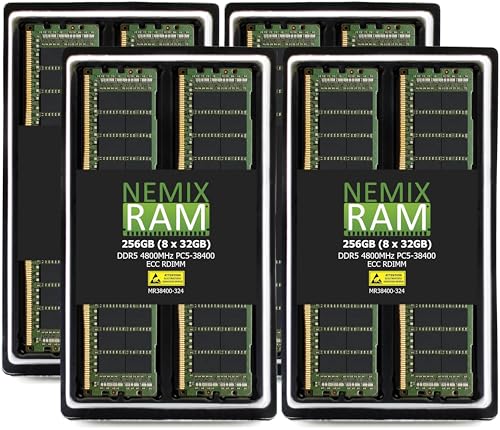
Nemix RAM 256GB DDR5 4800MHz ECC RDIMM Kit
Best for: Enterprise server memory expansion
- ECC Support
- ECC (what this guide is about)
- Capacity
- 256GB
- Memory Speed
- 4800MHZ
- CAS Latency
- CL40
- Kit Configuration
- 8X32GB
- Form Factor
- 288-PIN RDIMM
View on Amazon: Nemix RAM 256GB DDR5 4800MHz ECC RDIMM Kit Affiliate link
This is a 256GB DDR5 server memory kit. It uses eight 32GB modules running at 4800MHz. The kit features Registered ECC technology. This architecture buffers memory traffic. It protects data from single-bit errors. The 1.1V voltage and CL40 latency match enterprise standards. You need this for Sapphire Rapids or Xeon Scalable systems. It ensures stability in high-capacity server builds.
Pros
- 256GB total capacity across eight 32GB sticks
- Registered ECC corrects single-bit errors
- 4800MHz speed with CL40 latency
- Compatible with major server platforms
Cons
- Requires server-grade RDIMM slots
- Higher latency than consumer desktop RAM
- Only fits registered memory controllers
Good fit if
- You run Xeon Scalable processors
- You need maximum memory capacity
- You require error correction for data integrity
Skip if
- You use standard desktop motherboards
- You need non-ECC Unbuffered DIMMs
- You prioritize low latency over capacity
Verdict: Nemix RAM 256GB DDR5 4800MHz ECC RDIMM fits enterprise servers needing large, stable memory pools. It does not work for standard desktop PCs.

TEAMGROUP Elite 32GB (2x16GB) DDR5 4800MHz UDIMM Kit
Best for: standard desktop upgrades with basic error correction
- ECC Support
- Non-ECC (what this guide is about)
- Capacity
- 32GB
- Memory Speed
- 4800MHz
- CAS Latency
- CL40
- Kit Configuration
- 2x16GB
- Form Factor
- 288 Pin UDIMM
View on Amazon: TEAMGROUP Elite 32GB (2x16GB) DDR5 4800MHz UDIMM Kit Affiliate link
This is a 32GB DDR5 kit running at 4800MHz with CL40 latency. It uses 1.1V voltage and features a 2x16GB configuration. While it lacks standard ECC, it includes on-die ECC for self-correction. This setup suits users seeking basic stability without the complexity of registered memory. It fits standard desktop PCs that support UDIMM modules.
Pros
- 32GB total capacity in a 2x16GB kit
- On-die ECC for self-correction of DRAM cells
- Standard 1.1V operating voltage
- 4800MHz base memory speed
Cons
- No standard ECC support for server-grade error checking
- Lower 4800MHz speed compared to higher-tier options
- UDIMM form factor limits compatibility with some high-end boards
Good fit if
- You need a standard 32GB upgrade for desktop use
- You want on-die ECC for basic data integrity
- Your motherboard supports DDR5 UDIMM modules
Skip if
- You require registered ECC for server reliability
- You need speeds faster than 4800MHz
- You are building a system with limited UDIMM support
Verdict: TEAMGROUP Elite DDR5 32GB 4800MHz offers a balanced mix of capacity and basic error correction. It is a solid choice for desktop users who prioritize standard compatibility over high-speed performance.
Specifications side by side
| Spec | Nemix RAM 256GB DDR5 4800MHz ECC RDIMM Kit | TEAMGROUP Elite 32GB (2x16GB) DDR5 4800MHz UDIMM Kit |
|---|---|---|
| Capacity | 256GB | 32GB |
| Memory Speed | 4800MHZ | 4800MHz |
| CAS Latency | CL40 | CL40 |
| Kit Configuration | 8X32GB | 2x16GB |
| Form Factor | 288-PIN RDIMM | 288 Pin UDIMM |
| Voltage | 1.1V | 1.1V |
| ECC Support | Registered ECC | Non-ECC, On-die ECC |
| Compatible Device | Server | Desktop, PC |
| Size | 256GB (8X32GB) DDR5 4800MHZ RDIMM | 32GB |
| Dimensions | not stated | 5.91 × 50 × 30.3 inches |
| Weight | not stated | 0.53 ounces |
| Color | Black | Dual Channel |
| Model | not stated | TED532G4800C40DC01 |
Frequently asked questions
Can I use ECC DDR5 RAM in my standard desktop PC?
No, you cannot. The Nemix RAM 256GB kit uses RDIMM form factor, which is designed specifically for servers. Standard desktop motherboards do not support Registered DIMMs. You must use Non-ECC UDIMM modules, like the TEAMGROUP Elite kit, for typical desktop upgrades.
What is the difference between RDIMM and UDIMM?
RDIMM stands for Registered DIMM, which includes a buffer to handle higher memory loads, making it suitable for enterprise servers. UDIMM is Unbuffered DIMM, used in standard desktops. The Nemix kit is RDIMM for server stability, while the TEAMGROUP kit is UDIMM for general PC compatibility.
Does Non-ECC memory correct errors?
Non-ECC memory does not actively correct data errors in real time. The TEAMGROUP Elite kit provides basic error detection but relies on the system to handle issues. For critical stability and automatic correction of single-bit errors, you need ECC support found in server-grade modules like the Nemix kit.
Is 4800MHz fast enough for DDR5?
Yes, 4800MHz is a standard base speed for DDR5 memory. Both the Nemix and TEAMGROUP kits operate at this frequency with CL40 latency. This timing profile offers balanced performance for their respective uses, whether for large server memory pools or standard desktop capacity upgrades.
Which RAM is better for large capacity needs?
The Nemix RAM 256GB kit is better for large capacity. It provides 256GB total using eight 32GB modules, ideal for enterprise servers. The TEAMGROUP Elite kit offers 32GB, which is sufficient for desktops but lacks the massive pool required for high-end server workloads or virtualization.
Can I mix ECC and Non-ECC RAM in the same system?
No, you cannot mix them. ECC and Non-ECC modules have different internal architectures and signaling. The Nemix RDIMM requires a server motherboard with ECC support. The TEAMGROUP UDIMM requires a standard desktop motherboard. Mixing types will prevent the system from booting or cause instability.